Written eighteen hours ago on the plane, published now.
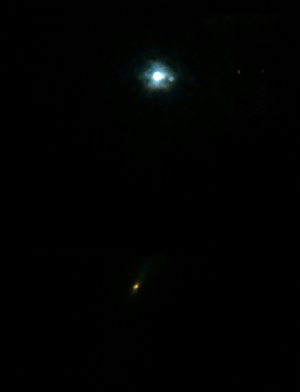
The actual moon, and the reflection. I didn’t have a flash on, so you can’t see the wing.
The moon is reflecting off the wing outside my window. The reflection is harvest-orange, but the actual moon is white as bone. I can see the wing, but my camera cannot.
Back when Usenet (a time marker I actually think is perfectly adequate–distinct from most social media currently in vogue in that it was a real PITA to edit your posts), there was this term I ran into on one of the newsgroups I spent time on, and that term was “Gothic Super Hero”. It referred to someone who worked a well-paying job that could pay for all of their awesome clothes and makeup, and whose workplace was totally fine with them showing up in full regalia, which was convenient because they always had time to put it all on, and…
(Yes, I spent time on alt.gothic.fashion. Hush.)
Anyway. The point was, you did not need to try to be that person. It was, in fact, quite possible that that person did not even exist. And it was okay to not be that person.[1]
My point is, I am sitting here, with my phone, and I feel that if I had the wherewithal, I could actually write a moderately pithy, incisive, anecdotal post which would entertain. I feel, obscurely, that I should be able to.
But I’m not that person. I’m tired and sick and mostly I’m okay with that. So this is what you get: the moon’s reflection is a harvest moon, and I remember first learning that it was okay to not be as cool as the people online seemed to be, and I’m going to try to sleep.
—
[1] Tangentially, when I first got onto the internet, when I was very young and visiting an aunt’s, I read several short horror stories.[2] One them involved a usually exquisitely dressed goth who was murdering people that saw her in frumpy glasses and pink knock-around clothes. PINK. The horror.
[2] This comes as a surprise to precisely no-one.
Currently sitting in Detroit, watching everything go by. The Gadgets To Go store where I was going to try and get an SD card for the camera had been replaced by a Coffee Beanery, so still no joy on that.
I had a bagel. I’m not hungry, but I know I’m not likely to get anything except possibly airplane breakfast for ten hours, by which point it will be lunchtime, and I suspect the not being hungry might be a touch of a headcold. Will probably eat and get a warm drink on the general principle of it being good for me, even if I’m not feeling it.
The windows are a little tinted (actually, it looks like they’re ZipToned, but you know what I mean, right?), so it’s hard to tell exactly, but it looks like there is some serious rain coming in; there are slate-gray clouds overhead, and they’re reaching all the way to the treeline in one corner of the window. I will not be surprised if there is a delay; there is always a delay, and the fact that there hasn’t really been one yet (we got in to Detroit ~half an hour late, but whatever) means I am waiting for the hammer to fall.
If there is a delay, I will cope. I have my laptop, my phone, thirty new magazines plus a Wasteland novella on my ereader, and knitting that I might feel more up to addressing once I get yet more orange juice. I’ve had four glasses of it since lunch. Also a complete willingness to ignore all these and doze if that is what will make me feel better. So, you know.
(I realize this is kind of boring, but typing helps me relax. So.)
…dammit, I wish that title weren’t so apt. Anyway.
I’m leaving for Loncon in ten days, and I am trying to decide whether or not to bring my laptop, and if I bring it whether to keep it in my (non-con-located) hotel room or take it with me to the con.
(Important note, for deciding: I can keep the con schedule on my phone.)
If I leave it at home:
pro: it will not get lost.
con: my laptop. Life without my laptop for eight days. In airports. (I will note that I have not had an international plane trip not take an extra half-day at least in years.)
If I take it to London and leave it in the hotel:
pro: I will have all my writing, my Skype, my bookmarks, my GDrive connection, my everything
pro: I can write while in transit. I find I actually really like doing this, and while it is technically possible to do on my phone, the smaller screen makes it much more of a PITA.
pro: I will not have to carry it around a con (I have a Lenovo Thinkpad; sturdy as all hell, but kind of bulky)
???: I would need to get a laptop bag. My current laptop bag is actually a backpack. No-one who is at risk of standing behind me or in my blind spot wants me maneuvering in a crowded area with a moderately heavy backpack, even with padded corners.
con: I would need to leave it in the hotel, which would probably be perfectly fine but which would, for at least the first two days, distract me.
If I take it to London and to Loncon:
pro: will have all my writing, my Skype, my bookmarks, my GDrive connection, my everything.
pro: I can write while in transit.
pro: can sit in A Spot at the con and get stuff down. (At Anticipation–the Montreal 2009 WorldCon–I ended up posting eight times from the con itself. Admittedly at that point I was in the con hotel, which makes a slight difference… OTOH, judging by FarthingCon, I really do like having my laptop with me. The “back off, breathe, find a place to sit for late-night coffee or dessert, and type” is a nice way of processing events.)
con: carrying around a heavy thing, which means that if I pick up anything else (get thee behind me, dealer’s room) or am carrying anything else (such as books to get signed), the total weight will be that much greater.
con: will need to lug it along if/when I decide that I should go somewhere/do something else.
Ugh. I don’t know. But at least I have every pro and con I can think of down, so I may revisit this in a bit. Thoughts?
Okay, here’s a question: I am looking for examples of fictional narrative in which the author and the reader both know and learn more about the world than the narrator/protagonist/viewpoint character(s).
Examples of what I am speaking of, off the top of my head:
“Petey” – TED Klein
“The Events at Poroth Farm” – TED Klein (I sense a theme)
“Fat Face” – Michael Shea
that story whose title I can’t remember from the New Cthulhu: The Recent Weird anthology in which the narrator assumes he’s observing the behaviour of crayfish
(The latter three are probably easier to pull off, in that the protagonists discover the facts they are ignorant of before the end of the story. “Petey”, on the other hand, remains a story that in this regard is so beautifully executed I am in awe every time I read it. I will probably be picking it up to look at it, but )
The important thing to note in these stories is that the truth of the fictional narrative is not the reader’s default reality (or, if one of these was set in Regency England or Ancient Egypt, their assumption of what a default reality should be). “Fat Face”, for example, involves shoggoths; assuredly cuddly, but generally not assumed to exist in real life. Contrast this with any one of three dozen narratives in which someone is running around the street seeing ordinary people as “demons”; I am really not hugely interested in examples of the latter, since they are generally a way to tell the reader about the narrator and not about the world.
Finally, I’m looking for text only. This means that things like the I Am Legend movie do not count. It is a wonderful example of how what the viewer can see is really going on (as displayed on film) does not match what the protagonist asserts is going on, but I really want to see how this is made to work in text.
Over the last few years, I’ve been making an effort to log more of my reading on GoodReads. (Lately I’ve also been looking at BookLikes, but that is a bit of an aside.) A fair bit of the stuff I read isn’t already on GoodReads, or has incomplete records there–authors are missing from anthologies, cover photos aren’t provided for books, standalone stories or small epubbed collections aren’t in the system. Usually I grumble about this a little and correct it.
(Someday I’m going to put all the old Hell on Earth stuff into a proper series list, oh yes. Organized by publication number and everything.)
Since I’ve been commuting a lot lately, I’ve been reading a lot more epubs–picking up some old stuff, picking up some new. And one of the things read earlier this week was a collection of draft stories and partials that you could get being a sponsor during the Clarion West Write-a-thon last year.
It’s not for distribution, which is fine; it is something which does not belong in GoodReads at all.
And it feels so weirdly good to read something that I don’t have to track.
(I mean, I don’t have to track what I read in GoodReads, of course. But it’s become an ingrained habit now, and the yearly challenges have a gamified appeal.)
I suspect this is exacerbated because I’m a bit stressed at the moment, and have a lot of things going on. Still, it’s worth keeping in mind, and perhaps I will clear myself a block of time when I can just read and give myself permission to not document it. I am already behind on reviews of books that really deserve it (can I just mention This Strange Way of Dying, which really needs more love), and I don’t imagine it would help with that. But at the same time writing reviews is actually pretty hard for me, and I think the breathing room–official self-given breathing room, rather than falling-behind-and-not-doing it–might feel lovely.
I have a fair number of books. (I’ve met people with more, so I don’t say I have a lot of books–I think it’s still under two thousand.) Occasionally, I go through my books and either garage-sale or give away ones I’ve decided I don’t care to keep. It took a fairly long time to come to terms with being someone who would get rid of books (a digression for another time), but it feels good to have the clutter gone, and to know that the books are not being kept in a place where they are not being read.
I can’t do this with ebooks. Rather, I have not yet figured out how to do this with ebooks.
Overwhelmingly, the way I get ebooks is through a service–Kobo, Smashwords, Weightless Books, emagazine subscription, DriveThruRPG, what-have-you–which requires me to create an account. The ebooks I own are associated with that account; if my computer explodes or if my ereader is run over by a stampeding moose, I can log in to my account from another computer and get fresh copies of said ebooks.
This makes it fairly hard to get rid of them.
I don’t want to give them away when I still own copies. I sometimes don’t have the option of not owning copies; it’s actually fairly frustrating to try and figure out how or if I can move something into a “yes I own this, stop reminding me” category and then duplicate that in Calibre, when I need to juggle scripting permissions to even log in (Kobo, I am looking at you), although a lot of the services are getting better about that.
I appreciate that ebooks don’t take up physical space. I do. But they’re still potential clutter, and if I am looking at a pile of badly sorted, unclearly organized, occasionally unwanted books, then my situation is not actually substantially better because the pile exists on a screen.
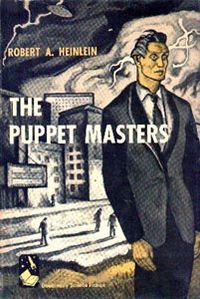
Not the edition I would have picked up in that bookshop.
Okay, that’s a lie. I read a Heinlein novel during a university course on science fiction. It was Starship Troopers, and it was contrasted with Haldeman’s Forever War. And I may have read part of The Puppet Masters, but since I only remember a bit about how some clothing (hats? coats? tops?) was being outlawed, it is more probable that I just picked it up at the neighbourhood secondhand bookstore and read a few pages. I liked to hang around the SF section and do that sometimes, and it’s left me with an eclectic collection of snippets–that bit, something about a Doctor Who novelization in which a villain had attached a canister of horrible mutagen to Peri[1], and a rich tourist who went to the Savage Theme Park of New York and was stuck there after it was closed for the season.
(Those bits are rather vague, since I would have been between seven and eleven at the time–more than two decades ago.)
But when I was growing up, I didn’t read Heinlein.
I have been thinking, lately, about a line from Toni Weisskopf’s blog post, “The Problem of Engagement,” which runs:
Well, Heinlein is one of the few points of reference those fans who read have. Of course we all read Heinlein and have an opinion about his work. How can you be a fan and not?
I am a fan who reads; horror by first choice, yes, but I always read SF and fantasy when there wasn’t enough horror around. I have loved Worlds-That-Are-Not (or Worlds-That-Are-Not-Quite) for many many years, and I found them through books. I have been, I would have said, one of those “fans who read” for a very long time.
But I didn’t read Heinlein.
See, the first time I picked up Heinlein with a recognition of who the author was supposed to be (this name I’d heard about, seen on book spines, was told was incomparable), in the hope that I would enjoy it? I would have been about twelve; my family was in Algeria at the time, and the English fiction library we had access to was in a repurposed basement. The entirety of the genre section was a single bookshelf, and I made a heartfelt effort to go through all of it.
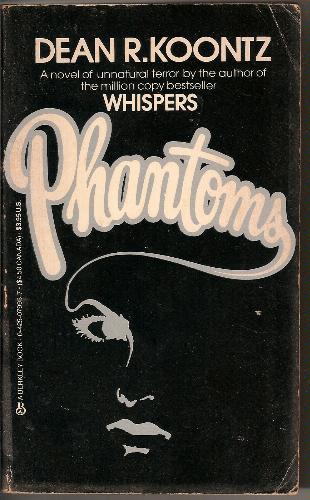
This, on the other hand, is the exact edition of Phantoms I read in that library.
I’m going to digress for a moment, and talk about Dean Koontz.
I discovered Dean Koontz and Stephen King on that same bookshelf (while I’d seen a secondhand hardcover of Cujo a few years earlier, I hadn’t been allowed to read it). Dean Koontz was easier to get a hold of, and often more snappily paced, and I would guess I read a good twenty or so of his books in the next few years. I probably overdid it, and I’d occasionally joke about how I could summarize the commonalities of plot of his novels in a single sentence. I got bored with him, and quit reading. (I’m drifting back, now, but that’s another story.)
But.
When I was twelve, when I was bored and had basically no-one to talk to, when I was starving for something to read and I went through that bookcase, here is what I found in the first handful of pages:
The first Heinlein novel I picked up, I read about a guy watching his daughter strip her top off and being proud that she was checking with her husband instead of with him to be sure it was okay.
The first Koontz novel I picked up, I read about a doctor who was taking care of her little sister and who’d bluffed an evil biker gang leader[2] into believing that she was too damn scary to mess with.
Goddamn right I wasn’t interested in more Heinlein. And my take on his work is and remains “I don’t know it,” and I don’t think that’s informed or detailed enough to count as an opinion.
And when I was back in Canada… well, I met other people I could talk to about this genre thing, and we swapped recommendations, and I know some of them liked Heinlein but none of them ever made anything he’d written sound cool enough for me to bump him onto my must-read list. And then there were things like university and work and now, sad as it makes me, I don’t have the time to read that I used to. For a little while in eighth grade I was getting through five books a week. These days I’m lucky to clear eighty books a year.
It doesn’t make me happy, but I can live with that.
So when it comes to the question of
Of course we all read Heinlein and have an opinion about his work. How can you be a fan and not?
It’s not that hard. You just find other things that suit you better, and listen for things that people describe in such a way that they sound actually enjoyable, and you don’t have unlimited time.
And to that, Weisskopf wrote:
So the question arises—why bother to engage these people at all? They are not of us. They do not share our values, they do not share our culture.
I can live with that, too. And my reaction to that is much the same as my reaction when I put down Number of the Beast. I don’t have time for this, I have not seen enough to suggest I will enjoy this, and so I will leave this behind and go find something that will brighten or deepen or enrich my day.
And if that decision means I am not of your culture, that I do not share your values, I am sure we will both be much happier for it.
—
[1] Unsurprisingly, it didn’t work. If I recall correctly, the mutagen canister was removed from where it was attached to Peri’s belt, and was ?thrown? at the villain, where it interacted with a wooden stake he was standing near. The mutagen then worked on the wooden stake, causing it to explode outwards into a spiky lattice of stake-y wood and skewer the villain to death.
[2] I am not saying Phantoms was particularly nuanced. (Jeter, the man in question, is further developed later in the novel. I would say the development was done to add horror, not subtlety or multi-faceted characterization.)
If we ever get this in our biweekly basket, I am leaving.
We’re subscribing–I think that’s the word?–to a Community Shared Agriculture program this summer. We’ve decided to go with only once every two weeks, since last year we got a weekly box of produce, and it got a bit overwhelming.
(Kale. I had no idea there could be so much kale. And I pretty much gave up on hand-carrying things back from the pickup point after they started giving us watermelons.)
We got the box last week. Wednesday, I made a concerted effort to use up as much as possible, and made a dinner of garden salad, oil-citrus-garlic dressing, roasted asparagus with Parmesan cheese, and rhubarb crumble. This only used up half a cucumber, the mixed package of spring greens (five plants and seven herbs!), all the rhubarb, and some of the asparagus. (I mean, it used up more, but I’m strictly discussing things which came in the produce box.) There was enough salad for a second meal since then, and we’ve also used up the tomato.
This leaves us with
half a cucumber
Lebanese cucumbers
beets and radishes (I suspect I will make these into the backbone of a lunch at some point)
spinach
arugula
a yellow pepper
two more asparagus bundles
a squeezy-bear of fresh honey
some of a dozen eggs (we hardboiled some right away)
a beeswax tealight
Pretty sure we can get through that before the next box comes in. (Maybe not the honey, but honey keeps.) And having them around does make it a lot easier to eat well. It’s kind of like the fridge is gently nagging me to empty it, like a cute little inversion of “feed me, Seymour.”
I understand that there’s going to be an announcement about the Hugo voter packages very soon. In the meantime, if you’re looking for a coherent list of links to what’s available online, you could do a lot worse than check out John DeNardo’s roundup at SF Signal. It’s huge.
The light of my life got me a Razer keyboard today–the BlackWidow. I saw one in… September or so, I think, wanted it very badly, and then it had sort of slowly slipped off my radar in the intervening months.
takketa
I may have made extremely undignified joyful squeeing noises upon unwrapping it. I am just saying.
This is a mechanical keyboard, which means (1) ultra-satisfying clicky noises–
clikclikclik tic tic takketa tap clik
–and tactile feedback, (2) lasts maybe ten times as long as your average keyboard, and (3) could probably serve as a blunt instrument in a (small) zombie emergency. It also has braided sleeves on all the cords, and when I say all the cords I mean that this thing has a power USB connection, a data USB connection, and runs speakers/headphones and mike out of the little port on its side. It comes with macro keys, and multiple settings, and software that backs all your custom settings up to the cloud so that when you get a new keyboard, you don’t need to fiddle around rebinding and re-entering all your custom setups, not that I am envisioning getting a new keyboard anytime soon because mine and it’s delightfully clicky.
clickety
The keys are slightly narrower than my old keyboard; they’re small squares, rather than subtle oblongs. I need to sit back a bit, instead of vulturing over my keys. Obviously, I will have to use this a whole lot in the coming days to practice.