Incluing at one remove

I’ve realized there’s a specific kind of world-building I’m interested in, and I’d love examples of it, if anyone has them: the kind in which the reader learns a truth about the world that is not apparent to the narrator/protagonist/viewpoint character(s).

Examples, off the top of my head

  • Petey” – TED Klein – probably the most full-fledged example of the lot, for reasons described below. None of the people attending the house-warming party know what’s going on. The attendant taking care of the former house owner doesn’t know what’s going on. None of them ever realizes during the text. But the reader understands.
  • The Events at Poroth Farm” – TED Klein (I sense a theme)
  • Fat Face” – Michael Shea
  • The Essayist in the Wilderness” – William Browning Spencer – the narrator assumes he’s observing the behaviour of crayfish. Those are not crayfish.
  • The Steerswoman series – Rosemary Kirstein

(The latter four are probably easier to pull off, in that the protagonists discover the facts they are ignorant of before the end of the story, but at a point where the reader already knows. “Petey”, on the other hand, does not do this and remains a story that in this regard is so beautifully executed I am in awe every time I read it. This makes it really difficult to dissect and analyze.)

It’s interesting that, with the Steerswoman exception, these are all relatively short works; two short stories, and two novellas. I imagine this might be the kind of thing that’s fairly hard to do without the reader growing exasperated that the characters haven’t figured it out.

Important Clarifications

Multiple viewpoint stories don’t inherently count. For example, in The Diamond Age, the reader knows more about the world than Nell and Hackworth and Judge Fang know individually, but what they know are factual details which are plausible within the presumed reality of the setting. The reader does not come away knowing that the world is reset-to-new-default-every-night-at-midnight in the manner of Dark City; that kind of thing would be a greater and occulted truth about the nature of the world, and not a default assumption within a future-set nanotech-driven earth. What I’m looking for is not merely a case of factual details being revealed, but of larger and different truths about the nature of the world being revealed.

The truth of the fictional narrative is not the default reality presented in the narrative. “Fat Face”, for example, presents a modern street-level existence; shoggoths are not assumed to be part of that default reality. The Steerswoman series presents a quasi-medieval-fantasy world which contains magic and which is just beginning to develop technology; the actual truth of the world contains things which are not assumed to be part of that default reality. But in reading each story, the reader learns a thing that they would not assume to be true based on the premise of the world.

Stories in which the narrator perceives A Secret don’t count. For example, say they’re running around seeing ordinary people as demonic creatures/animal-headed being which reflect their true nature/aliens only spottable with special sunglasses. If the narrator is right, then the reader doesn’t learn more about the world than the narrator. If the narrator is wrong, then the reader learns that the narrator is unreliable, and nothing special is revealed about the world.

(Technically you might be dealing with an unreliable narrator, but in a way which can also be reasonably described as them being an ignorant narrator.)

Finally, I’m looking for text only. This means that things like the I Am Legend movie do not count. It is a wonderful example of how what the viewer can see is really going on (as displayed on film) does not match what the protagonist asserts is going on, but I really want to see how this is made to work in text.

With all that said…

Suggestions? I’d love to read more of these.
Counting ink, 2015.

Now is the time for minutae-minded individuals to get bogged down in idly typing up details, so I’m posting about my reading and writing this year.

Reading

In 2015, I aimed for 70 books and finished 82, covering a total of 22535 pages.

Four of the books I read I five-starred on Goodreads, which is a rating I reserve for books that I think people should read even if they usually pass over that genre (A Gift Upon the Shore, “Sugar“, After the End, and Feeling Very Strange). The first is a novel, the second is a standalone short story (although it’s set in the Tabat universe, which also contains the really really lovely “Events at Fort Plentitude“), and the other two are anthologies.

Two of the books I read I two-starred, which means I did not hate them but pretty much stopped enjoying them and ground on to see if they would get better. If they had, I would have rated them higher.

And the oldest book I read this year was Fritz Leiber’s Gather, Darkness!, first published in 1943.

Writing

I submitted stories 56 times in 2015. I also got 49 rejections (one shy of a deciBrad, which I have decided is the correct term for ten centiBrads!), but three were from stories submitted before 2015, so you can say I only got 46 2015 rejections. (In 2014, those numbers were 34 submissions, and 31/30 rejections.)

I also got four acceptances, which was four more than last year. Or ever. Three of them have already been published; they’re linked over here.

This means I’ve got six stories out at the moment. I’m hoping to manage seventy submissions next year; will see how it goes.

Happy New Year! See you on the other side.

Come and get some mercy.

Well, season 2 of Z Nation is complete and I am giddy.

There are other shows with zombies (I am pretty sure… although these days I’m only watching iZombie, and it kind of doesn’t count). There are other shows with pulpy, bright-and-quickly-drawn characters.  There are other shows with kind of cheesy premises that carry themselves through sheer momentum.

But.

Read more Come and get some mercy.

A shining example to humanity.

Lately I’ve been… hmh. Rediscovering my fannish side, I suppose. Fallout 4 is coming out in 17 days (and 14 hours and 7 minutes and yes I think it is perfectly normal to have a countdown timer on my phone), and Hallowe’en is coming up sooner, and there is a local convention that has specifically mentioned costuming and there is also an okay to wear costumes at work.

Also the light of my life got me a PIP-Boy. So there’s that.

I am not a good costume-maker, for the record–my interest only tends to spike far-too-close to an event for me to comfortably have time to assemble something–but I am mucking about a bit with assorted paints applied to existing objects. What I am hoping for will be a very low-grade costume, no more remarkable than a sports jacket, but I hope it will be fun.

He made it all the way to 1997 New York, but he’s a little rougher than he used to be.

Still collecting fingers, though.

(Those’ll be shots from Escape From New York and Jonathan Strange & Mr. Norrell, respectively.)

Twenty minutes into the Future…

During the entirely too excessive amount of time I spent on planes yesterday, one of them offered Mad Max[1] as an in-flight movie. And I saw the summary and grumbled, because the summary ran

In a post apocalyptic world, Australian policeman Max seeks to avenge the death of his family at the hands of bestial marauding bikers. (115 min)

Mad Max, I maintain, is not a post-apocalyptic movie (and dammit, you hyphenate that when it’s an adjective). I would listen to arguments that it’s a world in the slow beginnings of an apocalypse as society crumbles into a new dark age[2], but it ain’t post-apocalyptic. There wasn’t an apocalypse.

I do think it’s part of a really identifiable sub-genre of dark dystopias that are very low science fiction (if any) and that I think tend to get lumped into SF because they’re set “technically in the future” rather than because they’re movies about the effects of a new technology. I mean, things are in the future and it’s different and bad–that’s part of what SF is, right?

(We shall now pause for a regularly scheduled observation that if all SF was was complaints about how everything was going to hell, it would not deserve its title as “the literature of ideas”. Future rants about the reactionary nature of time travel may follow.)

But these movies… you know the kind I mean, right? The setting of Mad Max is undermaintained and there’s been a decay of the social order for some unspecified reason, but that’s it. Escape from New York came out in ’81, and there really isn’t any new technology in there; a bunch of it was probably developed during World War III, but that never really comes up. Dead End Drive-In is a low-tech (and very low-budget) excuse to pen a bunch of unemployed hooligans up in a isolated parking lot and leave them there.

I’m not saying these different-society-plausible-technology movies are bad. Some of them are bad. Some of them are fun. Some of them are pretty cool.

But I really don’t think they’re speculative fiction, and I wish I had a name for the sub-genre. I suppose they’re dystopias, or possibly just near-future dystopias, but I kind of wonder if someone else has already thought about this and come up with a better name.

(NB: Not saying the subgenre of “twenty minutes from now, it’ll be the grim dark future” is exclusively low or no SF–you can look at Rollerball, Death Race 2000, or RoboCop for counterexamples. Or Max Headroom, which is the source of the post’s title. And I have a bit to say about both Max Headroom and RoboCop, but it’s actually still 10 p.m. on my body clock and I think I need a nap, never mind all this sunshine.)

[1] Not Road Warrior, not Beyond Thunderdome, not Fury Road, just Mad Max.
[2] The distinction between apocalypse and societal decline is interesting, and one that I suspect largely has to do with framing and speed. (Possibly enhanced by weapons of mass destruction. I suspect that a society that crumbles without anyone having the potential to fire off nukes is going to do so rather more gracefully than a society with said potential, insofar as such processes can be called graceful.)

Oh. Shucks.

It’s kind of interesting, how many times black canids show up associated with death, and specifically the transition/boundary of death.

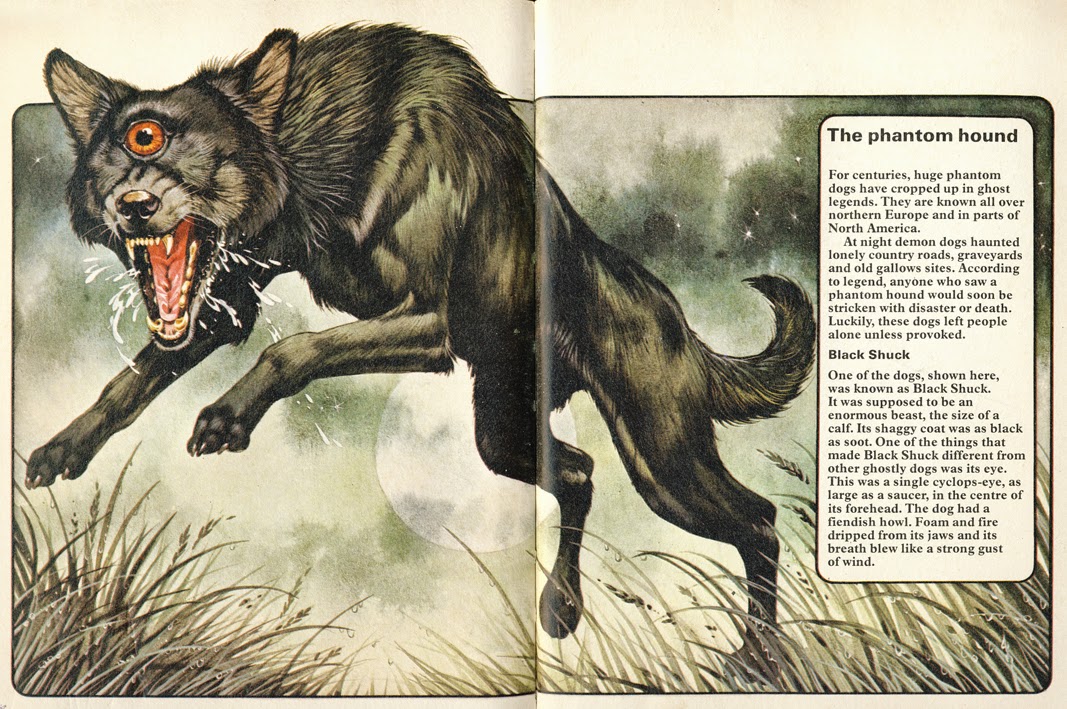
Off the top of my head, you’ve got Anubis who embalmed the dead and guided souls to the afterlife. (He also ) You’ve also got Cerberus, guarding the gates of the land of the dead.[1] But my favourite image in this regard–where my brain goes quickest, and what makes me smile–is Black Shuck. Black Shuck is an East Anglian creature of folklore; he’s a harbinger of death, and seeing him means you’re probably going to die soon.

Surprisingly enough, despite the less-than-friendly demeanour depicted in the image above, the stories mostly don’t seem to mean “soon” as in “as soon as he chews your leg off”. More of a “as soon as you have time for the full horror to sink in and to tell a few people” thing.

(That picture, by the way, is one I ran across around age six. I think I promptly adopted Black Shuck as the most awesome imaginary friend ever. You can do that kind of thing, when you’re six.)

To tangent briefly: the term Black Dog to refer to depression–as in the Black Dog Institute, or the “I had a black dog” animated video–was drawn from Churchill’s references to his bad moods as “a black dog on my back” (something akin to “getting up on the wrong side of the bed”), a colloquialism that also refers back to the black dogs of folklore.

I suspect black dogs have mostly been on my mind, however, because I recently reread Bob Leman’s “Loob“–in which the Goster County dogs are not friendly, not approachable, but ultimately a signifier that things may return to an idealised order, and are described as follows:

…almost a distinct breed, huge rangy dogs with blunt muzzles and smooth black pelts, who stood baleful guard over the farms of the county and patrolled the streets of the town with a forbidding, proprietary air.

It kinda fits.

[1] As to Norse mythology: I’m honestly not sure if Fenrir fits this mould or not. Canid, yes; associated with death, yes if you count the end of the world as a death; black, I really could not tell you. Garmr is a blood-stained watchdog that guards the gates of Hel, but again: could be lilac for all I know.[2]
[2] Probably isn’t lilac.

The proof is this…

The complete collected works of Bob Leman.

I have only ever read three Bob Leman stories.

I read “Instructions” long long ago; looking at ISFDB, it would either have been in the September ’84 issue of Fantasy & Science Fiction or the ’85 Year’s Best Science Fiction, years after it was published.

I read “Window” in The Best Horror Stories from the Magazine of Fantasy and Science Fiction collection. That was years after it was published, too. It stuck with me; I didn’t remember the author’s name at the time, though.

I read “Loob” in January of 2012. It was online at Weird Fiction Review, and I was sitting in an emergency room with a friend. It was very late and we were both zoney and tired, and I was reading the story on my phone. The language seemed like it could have felt stilted, but somehow it wasn’t, and the story pulled me along, and then I hit one of the lines and it chimed.

Weird Fiction Review had an article about Bob Leman, and I looked at that too. The description of “Window” pinged a memory, and I went to look at the Best Horror Stories collection and that was when I connected “Window” to Bob Leman.

I don’t remember when I connected “Instructions” to the story I’d read. I know it was before 2014, because when I was at the Tachyon Publications table at LonCon, I interrupted myself with “You have ‘Instructions‘ by Bob Leman? Wait, the Bob Leman?” and the gentleman manning the table very kindly told me that I was well-read, and then introduced me to The Boss in the Wall by Avram Davidson and Grania Davis, who I hadn’t heard of at that point.

(LonCon was a bit rough on my bookshelf space.)

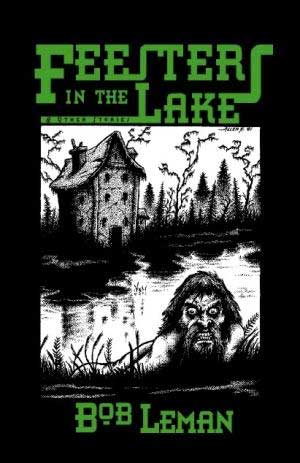
Anyway! I have been sadly poking around the Internet to see if there’s a copy of Feesters in the Lake that by some minor miracle is going for less than $250, and it turns out that while there isn’t, his daughter is hoping to put his complete fanzine online. So that will be something to look at and read through, as it goes.

In the meantime, I will sleep well, and dream of Goster County dogs.

Yellow.

The yellow sign.
Probably familiar. Probably.

I have (probably not very surprising) a kind of abiding fascination with the King in Yellow. An imaginary play created by Robert W. Chambers in 1895, it’s one of the go-to examples of the motif of harmful sensation; the sound or sight or text so horrible that it damages the one who experiences it.

(Incidentally, yellow appears as a colour associated with horror rather more often than I’d expect. Red and black are easy and obvious associations, and you can get a lot of mileage out of an eerie green light[1], but yellow… there’s the King in Yellow, Gilman’s famous yellow wallpaper, the sickening yellow haze in King’s room 1408, and another one just at the tip of my memory. It is a very unwell colour, I suppose.)

I am not the only one. (I own two anthologies devoted specifically to King in Yellow stories, and another one is coming out late this year.) There are stories which frame the King in Yellow as a play (Brian Keene’s “The King, in Yellow” is the only one I can think of off the top of my head, and several which frame it as a text, but several (including two of my favourites[3]) frame it as a movie. I can’t think of any other mediums of expression; I’ve never read a story about a King in Yellow video game, or dance performance. I can’t call to mind treatments of it as a story, either (that is, a work of prose fiction, rather than a script or a performance produced from a script).

That said, I do know that John Horner Jacobs’ Southern Gods features a detective looking for the recording artist Ramblin’ John Hastur. I have my suspicions about that, but I haven’t actually been able to lay hands on a physical copy of the book. (It’s on my to-do list.) It’d be interesting if there are King in Yellow references in there, particularly as Ramblin’ John is a blues musician; it’s an art form much more strongly associated with improvisation than scripted plays, and I’d be curious to see how the interpretation differs as a result.

[1] Or a regular light and a green skirt.[2]
[2] Kind of curious to see if I have tied this post into obscure knots, or if that reference actually makes sense.
[3] Those would by Orrin Grey’s “The Seventh Picture” and Silvia Moreno-Garcia’s “Flash Frame”. “The Seventh Picture” is in Candle in the Attic Window and Never Bet the Devil and Other Warnings, and “Flash Frame” is in Cthulhurotica, The Book of Cthulhu, and This Strange Way of Dying, and is in audio at Tales To Terrify No 9 David Thomas Lord. For the record.

I think it’s the insects’ turn.

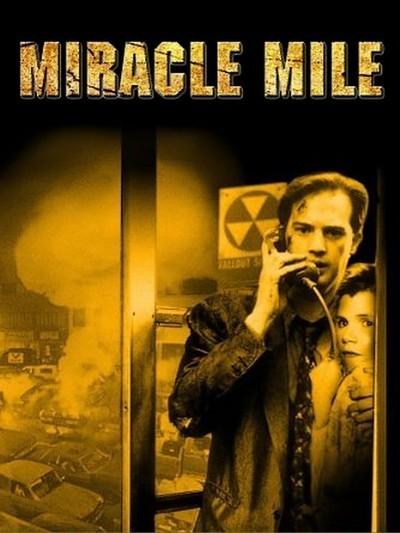
Poster for the 1988 movie MIRACLE MILE. I rewatched Miracle Mile tonight; last night, actually, by the time this post is done. (Spoilers follow.)

If you don’t know it; it’s a 1988 movie about a guy who accidentally gets a phone call telling him nuclear war is starting (has started? the missiles are locked in, at any rate), and LA will be nuked in 70 minutes. The rest of the movie is him trying to get to his girlfriend and escape the city.

He manages one of these things.

Miracle Mile is dated, and its pacing and dialogue make it a bit hard to approach, but it pulls itself together as the film goes on. Some of the scenes towards the end are surprisingly bleak; the frantic crawl through the traffic jam is something I’ve never quite seen a match for. And it is an unapologetically downer ending[1]; I find it rather touching as well, which mellows it slightly, but fundamentally this is a movie that unquestioningly accepts that  nuclear war is going to be the end of things and waits for the characters to catch up.

“People are going to help each other, aren’t they? Rebuilding things?”
“I think it’s the insects’ turn.”

I would love to see a remake of it, but I’m not sure it could be done. It seems very much a movie rooted in the Cold War; the idea that a nuclear war could happen, that it was such a real and obvious and accepted fear that with so little prompting people would behave that way. I think you could convey a world in which that fear was present, but I think that for the audience it might be a case of learning that fear, not recognizing that fear.

[1] I said, to the light of my life, “is it really that much of a downer?” And he said to me, “World War Three started, LA is nuked, the main characters drown in tar. It’s a downer.”
He has a point.