The quiet background.

A pair of hiking boots on rocky ground.
These boots were made for walking– and will take a skilled cobbler perhaps thirty work-hours to replace. When going among the radioactive hell-weasels, please try to get bitten primarily about the arms and face.

As surprises probably no-one, I am a fan of post-apocalyptic settings. (My boxed copy of Wasteland 2 came in recently!) But I was thinking lately about skillsets that would be useful in a post-apocalyptic setting that don’t get a lot of attention paid them.

Disclaimer: “post-apocalyptic” covers a huge range of stuff, from your generic brown whoops-the-bombs-fell-pass-me-my-gas-mask setting to Fritz Leiber’s chill dark “A Pail of Air” to the slow burn of On The Beach or Stross’s bureaucratically gleeful Mythos-drawing “A Colder War”. So yeah, not all post-apocalyptic settings require those skills, but they strike me as the kind of thing where it’s… hmh. Worth confirming that you don’t need them, if you don’t?

Cobbling. I mean, honestly, there is so much walking in so many of these settings; driving too, and the occasional ornithopter, but… shoes. Sooner or later the pre-existing shoes are going to be scavenged, or you’re not going to be in a spot where you can get more, or you’re just a really common size and everyone else got there first. And yet I don’t think I’ve ever seen or heard of a cobbler in a post-apocalyptic setting. Everyone’s too busy selling spit-cooked rat or something.

While we’re on rats and food… Food preservation is going to come up at some point, unless there is no way to ever raise, grow, hunt, or gather more than you need on a day to day basis. I, for one, have no idea how to can or preserve food (I think you boil it and then pour wax on it; I think I’m missing some critical steps), and would fully expect meat to rot before it became jerky.

Pharmaceutical training, too. Medical skills are a given (again, remember, this is not a discussion of skillsets that are obviously useful, it’s a discussion of useful skillsets that aren’t often paid attention to; this is why mechanics and doctors haven’t and won’t be mentioned), but even just knowing how drugs need to be stored and what interactions you can expect would be useful. Pharmacies in Canada at least often don’t print expiry dates on the prescriptions they dispense; it’d be nice to at least know where to look to find those.

Speaking of knowing things? Archival skills. It’s awesome that you have a printed copy of… well, Wikipedia and the Mayo Clinic site. But even leaving aside that modern paper tends to be acidic, what’ll you do when the black mold gets in? How’re you going to make more copies (where will you get the ink)? If it’s a single huge print-out, who’s going to index this in a useful way now that you can’t just click on a link?

I mean, I am sure there will be workarounds, and I’m not saying a post-apocalyptic setting needs these things, or needs to dwell on them. I am saying it is possibly quite cool to examine the possibilities of developing these things.

There are more, but I really do need to run off and Do Things. I just wanted to note this down while I had a moment.

Mnemosyne will this offset.

Bouncing around links, as one does, I ran across this post and while I am not currently speaking to the second point of the post[1], I think the first point is extremely on-point:

When you read an x-men book today, you’re not reading it because of what is in the actual book–you’re reading it because it’s the X-men and the feeling it gives you reminds you of positive memories you have of the very best of the x-men stories.

(No, obviously not exclusively!) But.

I read that and I remembered trying to explain what I felt about the second Hobbit movie, and why I’m probably going to go see the third. It wasn’t that it was good, really. It wasn’t that it was deeply moving, or well-paced. And I was trying to explain my reaction after and what I came out with was “It’s not that it’s good! It’s that it looks close enough to something that was good, when I read it when I was a kid, that I can use that to get back to how awesome it was back then.”

It’s like air being blown into a bouncy castle. >.> (An incredibly dignified image, I am sure you will agree.) It doesn’t have to be good air. It doesn’t have to have the whisper of summer-evening meadow-flowers, or the far-off breath of the sea, or have strains of far-off dwarven chanting[2]. It needs to be uncorrosive enough to not rot the bouncy castle from the inside-out. (And a nozzle that matches the valve on the bouncy-castle, I am sure, but here the metaphor is getting overcomplicated again.)

Just figured I would note down that particular case of a well-articulated point that clicked for me, because it is so bloody frustrating to not be able to set something out clearly.

[1] I am not disagreeing that it amy lead to a non-aspirational escapism, but I am disagreeing that a non-aspirational escapism deserves to be called “the worst” kind. But at that point you get into judging the values of escapism in terms of personal growth vs expansion of perception vs self-care, and I absolutely do not have time to do that at this point, so I will end this footnote now.
[2] “Gold, gold, gold, gold.”

Slow, sad, and mad

Bedlam vol. 1Bedlam vol. 1 by Nick Spencer

My rating: 4 of 5 stars

(written several months back, and published now that I am cleaning out my drafts)

…I haven’t been so hooked by a graphic novel since I picked up Uzumaki, Vol. 1. And exactly like when I picked up Uzumaki, I am swearing because the comic book store has closed for the day, and now I have to wait before I can see about getting the next one in the series.

Spoilers for the first twenty-odd pages follow.

Like it says on the tin: the generically utterly evil technically-not-supervillain-because-no-superpowers-but-come-on-now Madder Red has, after years of therapy, apparently been cured of his anti-social drive.[1] Now he’d like to do some good.

I picked it up expecting a crime story. In the first fifteen pages, it had me blinking a little at what was being depicted (villain cheerfully slitting a child’s throat in front of the hero), and then twisted the standard “ha-ha, holding the city hostage by means of threatening something terrible” schtick into an entirely new direction.

It’s a murder mystery, sure. It’s grim and fast-paced and makes a creepy kind of sense. It’s beautifully drawn; the story weaves along between modern-day (full-colour art) and flashbacks to various points in the past (black and white and red all over). I am going to go reread it, once I am done posting this.

But beyond that, it feels thoughtful in a way that comics about characters like this–characters that are like how Madder Red started out, I mean, he’s quite different in the modern day setting–usually don’t, and for “usually don’t” read “never have”.

Series was apparently cancelled after enough comics to make two graphic novels. I am saddened by this, but… I guess it ups the odds of being able to convince other people to read the whole thing?

[1] Dead kids. Lots of dead kids. And dead women. (He hurt and killed woman and kids by preference.) And dead cops. And along the way, dead cats. His backstory rap sheet is drawn in in relatively few pages, and remains the kind of thing which is jaw-droppingly violent in a way I cannot recall having previously seen in comics.

View all my reviews

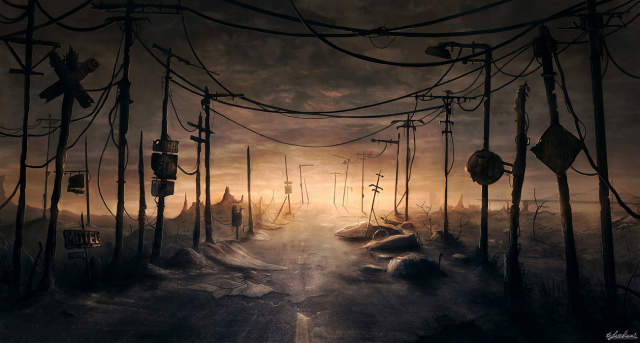
Post-apocalyptic vs post… well, post-something-else.

By Thibault Fischer; click for a better look.

A while back, I got into a discussion with someone about post-apocalyptic settings, and they referred to A Handmaid’s Tale as post-apocalyptic. It didn’t seem to meet the definition, but I didn’t have a chance to sit down and actually hammer out what I thought the definition was until now.

I think (and this is possibly heavily influenced by what I currently take for granted) a post-apocalyptic setting has two elements; an apocalyptic event[1], and a destruction of the larger social infrastructure. That might be because there are too few people left to sustain it, because the roads were ruined in the earthquake and roads are kind of essential, because the things that have lovely Victorian clothes and far too many teeth are coming through every fifteen hours and twenty minutes[2] and it’s completely shot everyone’s focus to hell… For whatever reason, the larger social infrastructure is gone.

(By the way, the Fractured anthology has some very good post-apocalyptic stories. Just saying. Also you can currently see it on my GoodReads feed, down in the widget corner.)

If you get an apocalyptic event without a destruction of the social infrastructure, then what you have is either a reconstruction setting or a dystopia, depending on how people reacted. (This is how I’d classify A Handmaid’s Tale or 1984 if they’d been precipitated by an apocalyptic event[3]. This is also how I’d classify Deadlands, actually, with a side-order of monsters so deep in the shadows that almost no-one knows that there’s been an apocalyptic event.) There’s an apparently stable and effective government operating on a federal level over a huge territory; if that is post-apocalyptic, it’s so far post-apocalyptic that the apocalypse has become irrelevant.

I don’t think a reconstruction setting needs to have that large or effective a government, mind. I’d call Fallout: New Vegas more reconstruction than post-apocalyptic, with the world starting to knit itself together again, and the territories claimed by the various factions certainly aren’t continent-spanning.

(Also, I will just note that I still have a spare Steam copy of F:NV to give away, because I collect them expressly for that purpose.)

If you get the destruction of the social infrastructure without an apocalyptic event, then what you have is… well, it’s rather cynical, and I can’t think of cases where I’ve actually seen it. But if it doesn’t have an apocalyptic event to have happened after then it’s by definition not post-apocalyptic, dammit.

Just some thoughts, I guess. Feels good to get them down, even if I’m not sure where they’re going yet.

[1] I am absolutely willing to count slow or soft events as apocalyptic–total economic collapse, widespread drought or famine, humanity becoming sterile[4], etcetera. Doesn’t have to be bombs or plague.
[2] I’m short-changing Bob Leman’s “Window” horribly, here.
[3] I personally wouldn’t classify the event precipitating the Republic of Gilead’s creation as apocalyptic, but I understand that if you find the story focuses closely enough on the US, you can consider it to be so.
[4] See [3]; if you turn the narrative focus from “things potentially affected by an apocalypse” down to the narrower focus of “humanity”, you can tell an apocalyptic story even when the vast majority of life on earth will be fine. See also “There Will Come Soft Rains“, and yes, that was a deliberate link to the poem and not the story.

Coming in fast, because music.

I mean, look at this cover.

Because rock’n’roll.

It’s been a really stressful few weeks, and I haven’t been saying much. (I got bitten by a German Shepherd last month, did I mention? Stupid owner.) I’ve been low on time and low on energy, but I ran across something and thought I should mention:

I ran into The Truth of Rock and Roll. (Scroll down.)

I’ve been tired enough that it’s been easy to drop onto TV Tropes and let it eat my attention and my time for fifteen, twenty minutes at a stretch (which is really longer than I’d like right now), and I wandered onto the page for The Truth of Rock and Roll, and…

At first I thought it sounded twee. But the tropes page mentioned a shout-out to that much-loved-by-me Walter-Hill-scored-by-Jim-Steinman this-is-where-the-80s-gets-kidnapped-by-the-70s-and-saved-by-the-50s heartsong of a movie Streets of Fire, and mentioned it was serialized on the author’s blog. And I figured, well, I’d take a quick look. Blogs are easier for me to read than ebooks, and if it’s serialized it’ll have natural breaking points, won’t take up too much time.

(It starts here, by the way. Five parts.)

Take a look.

Over the head of the narrator

Okay, here’s a question: I am looking for examples of fictional narrative in which the author and the reader both know and learn more about the world than the narrator/protagonist/viewpoint character(s).

Examples of what I am speaking of, off the top of my head:

  • “Petey” – TED Klein
  • “The Events at Poroth Farm” – TED Klein (I sense a theme)
  • “Fat Face” – Michael Shea
  • that story whose title I can’t remember from the New Cthulhu: The Recent Weird anthology in which the narrator assumes he’s observing the behaviour of crayfish

(The latter three are probably easier to pull off, in that the protagonists discover the facts they are ignorant of before the end of the story. “Petey”, on the other hand, remains a story that in this regard is so beautifully executed I am in awe every time I read it. I will probably be picking it up to look at it, but )

The important thing to note in these stories is that the truth of the fictional narrative is not the reader’s default reality (or, if one of these was set in Regency England or Ancient Egypt, their assumption of what a default reality should be). “Fat Face”, for example, involves shoggoths; assuredly cuddly, but generally not assumed to exist in real life. Contrast this with any one of three dozen narratives in which someone is running around the street seeing ordinary people as “demons”; I am really not hugely interested in examples of the latter, since they are generally a way to tell the reader about the narrator and not about the world.

Finally, I’m looking for text only. This means that things like the I Am Legend movie do not count. It is a wonderful example of how what the viewer can see is really going on (as displayed on film) does not match what the protagonist asserts is going on, but I really want to see how this is made to work in text.

Suggestions?

Depressurizing

Over the last few years, I’ve been making an effort to log more of my reading on GoodReads. (Lately I’ve also been looking at BookLikes, but that is a bit of an aside.) A fair bit of the stuff I read isn’t already on GoodReads, or has incomplete records there–authors are missing from anthologies, cover photos aren’t provided for books, standalone stories or small epubbed collections aren’t in the system. Usually I grumble about this a little and correct it.

(Someday I’m going to put all the old Hell on Earth stuff into a proper series list, oh yes. Organized by publication number and everything.)

Since I’ve been commuting a lot lately, I’ve been reading a lot more epubs–picking up some old stuff, picking up some new. And one of the things read earlier this week was a collection of draft stories and partials that you could get being a sponsor during the Clarion West Write-a-thon last year.

It’s not for distribution, which is fine; it is something which does not belong in GoodReads at all.

And it feels so weirdly good to read something that I don’t have to track.

(I mean, I don’t have to track what I read in GoodReads, of course. But it’s become an ingrained habit now, and the yearly challenges have a gamified appeal.)

I suspect this is exacerbated because I’m a bit stressed at the moment, and have a lot of things going on. Still, it’s worth keeping in mind, and perhaps I will clear myself a block of time when I can just read and give myself permission to not document it. I am already behind on reviews of books that really deserve it (can I just mention This Strange Way of Dying, which really needs more love), and I don’t imagine it would help with that. But at the same time writing reviews is actually pretty hard for me, and I think the breathing room–official self-given breathing room, rather than falling-behind-and-not-doing it–might feel lovely.

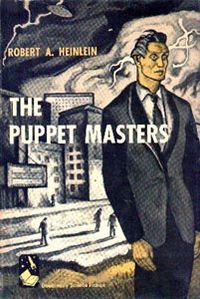
I didn’t read Heinlein.

Not the edition I would have picked up in the bookshop.
Not the edition I would have picked up in that bookshop.

Okay, that’s a lie. I read a Heinlein novel during a university course on science fiction. It was Starship Troopers, and it was contrasted with Haldeman’s Forever War. And I may have read part of The Puppet Masters, but since I only remember a bit about how some clothing (hats? coats? tops?) was being outlawed, it is more probable that I just picked it up at the neighbourhood secondhand bookstore and read a few pages. I liked to hang around the SF section and do that sometimes, and it’s left me with an eclectic collection of snippets–that bit, something about a Doctor Who novelization in which a villain had attached a canister of horrible mutagen to Peri[1], and a rich tourist who went to the Savage Theme Park of New York and was stuck there after it was closed for the season.

(Those bits are rather vague, since I would have been between seven and eleven at the time–more than two decades ago.)

But when I was growing up, I didn’t read Heinlein.

I have been thinking, lately, about a line from Toni Weisskopf’s blog post, “The Problem of Engagement,” which runs:

Well, Heinlein is one of the few points of reference those fans who read have. Of course we all read Heinlein and have an opinion about his work. How can you be a fan and not?

I am a fan who reads; horror by first choice, yes, but I always read SF and fantasy when there wasn’t enough horror around. I have loved Worlds-That-Are-Not (or Worlds-That-Are-Not-Quite) for many many years, and I found them through books. I have been, I would have said, one of those “fans who read” for a very long time.

But I didn’t read Heinlein.

See, the first time I picked up Heinlein with a recognition of who the author was supposed to be (this name I’d heard about, seen on book spines, was told was incomparable), in the hope that I would enjoy it? I would have been about twelve; my family was in Algeria at the time, and the English fiction library we had access to was in a repurposed basement. The entirety of the genre section was a single bookshelf, and I made a heartfelt effort to go through all of it.

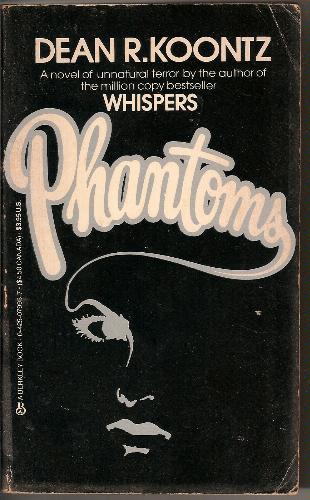
phantoms
This, on the other hand, is the exact edition of Phantoms I read in that library.

I’m going to digress for a moment, and talk about Dean Koontz.

I discovered Dean Koontz and Stephen King on that same bookshelf (while I’d seen a secondhand hardcover of Cujo a few years earlier, I hadn’t been allowed to read it). Dean Koontz was easier to get a hold of, and often more snappily paced, and I would guess I read a good twenty or so of his books in the next few years. I probably overdid it, and I’d occasionally joke about how I could summarize the commonalities of plot of his novels in a single sentence. I got bored with him, and quit reading. (I’m drifting back, now, but that’s another story.)

But.

When I was twelve, when I was bored and had basically no-one to talk to, when I was starving for something to read and I went through that bookcase, here is what I found in the first handful of pages:

  • The first Heinlein novel I picked up, I read about a guy watching his daughter strip her top off and being proud that she was checking with her husband instead of with him to be sure it was okay.
  • The first Koontz novel I picked up, I read about a doctor who was taking care of her little sister and who’d bluffed an evil biker gang leader[2] into believing that she was too damn scary to mess with.

Goddamn right I wasn’t interested in more Heinlein. And my take on his work is and remains “I don’t know it,” and I don’t think that’s informed or detailed enough to count as an opinion.

And when I was back in Canada… well, I met other people I could talk to about this genre thing, and we swapped recommendations, and I know some of them liked Heinlein but none of them ever made anything he’d written sound cool enough for me to bump him onto my must-read list. And then there were things like university and work and now, sad as it makes me, I don’t have the time to read that I used to. For a little while in eighth grade I was getting through five books a week. These days I’m lucky to clear eighty books a year.

It doesn’t make me happy, but I can live with that.

So when it comes to the question of

Of course we all read Heinlein and have an opinion about his work. How can you be a fan and not?

It’s not that hard. You just find other things that suit you better, and listen for things that people describe in such a way that they sound actually enjoyable, and you don’t have unlimited time.

And to that, Weisskopf wrote:

So the question arises—why bother to engage these people at all? They are not of us. They do not share our values, they do not share our culture.

I can live with that, too. And my reaction to that is much the same as my reaction when I put down Number of the Beast. I don’t have time for this, I have not seen enough to suggest I will enjoy this, and so I will leave this behind and go find something that will brighten or deepen or enrich my day.

And if that decision means I am not of your culture, that I do not share your values, I am sure we will both be much happier for it.

[1] Unsurprisingly, it didn’t work. If I recall correctly, the mutagen canister was removed from where it was attached to Peri’s belt, and was ?thrown? at the villain, where it interacted with a wooden stake he was standing near. The mutagen then worked on the wooden stake, causing it to explode outwards into a spiky lattice of stake-y wood and skewer the villain to death.
[2] I am not saying Phantoms was particularly nuanced. (Jeter, the man in question, is further developed later in the novel. I would say the development was done to add horror, not subtlety or multi-faceted characterization.)

Hugo helpfulness

I understand that there’s going to be an announcement about the Hugo voter packages very soon. In the meantime, if you’re looking for a coherent list of links to what’s available online, you could do a lot worse than check out John DeNardo’s roundup at SF Signal. It’s huge.

Myself, I’m keeping a list here, Read more Hugo helpfulness

Quick happy notes.

We went out to dinner tonight, and there was lovely happy fluffy conversation, ranging from Star Trek Online to the lives of various actors and former actors to BraveStarr (does anyone else remember that? I mean, without Googling?), and along the meandering way Mark Ruffalo came up.

He did not come up for long, but he is on my mind. Specifically his role as the Hulk.

(Okay, I hate having to do this, but: I am not speaking for all crazies. I am, in fact, speaking for myself, as a very lucky crazy, in terms of my privilege and support system.)

I love Mark Ruffalo’s Bruce Banner.

I love the way he’s so careful. I love the way he measures his speech. I love the way you can see him holding his own hands, so cautious; I love the way that when he’s dealing with people who know about and might want to use the Hulk his speech and body language, over and over, codes as a human being who has learned to second-guess himself, and to be hesitant.

I love this scene. I love how at 0:25 Cap–a good guy! A decent, fairly perceptive guy!–says it might be a good time to get angry.

How he actually thinks he might need to speak up and tell Banner it’s a good time to get angry.

(Oh, Cap. I’m sure you mean well. I know you mean well. I know you’re speaking up because you’re nervous, because you don’t understand how someone who is so calm and quiet could possibly be anything close to as angry as they need to be. But… shhhh. We’ve got this.)

And Banner doesn’t even blink. He explains, like it’s an obvious thing (and it is!), and then he unfurls.

(The Hulk is fundamentally a good and well-intentioned creature. This makes the Hulk different from, say, depression. But this isn’t about the Hulk, except in terms of how the Hulk casts Bruce Banner’s accomplishment into proper relief.)

Banner lives with this all the time. This thing inside him. This thing that is always there, that means that even when he is angry he has to manage himself, he has to not show it, because if he starts indulging himself and turns into Mr Shouty the way all the others do, it will go badly. Because his anger, released, is so much worse. It is terrifying. It is an annihilating force that results in a level of destruction that is incomprehensible coming from a normal human.

This is not fair. Banner has been robbed of the catharsis of expressing small, normal amounts of a negative emotion, in safe ways.

Banner is angry all the time. But he cannot let himself indulge. And so he looks hesitant, and he acts weak. And sometimes he lets go, and he’s the Hulk. And that’s cool, because this is after all the Avengers movie.

But the rest of the time, that quiet hesitant man? That still figure in the corner speaking in soft tones?

He’s holding back the Hulk.

With all he’s been through, while he was frightened and hunted and alone, dealing with unimaginable pressure, he has learned to hold back the Hulk.

I love Mark Ruffalo’s Bruce Banner.