Incluing at one remove

I’ve realized there’s a specific kind of world-building I’m interested in, and I’d love examples of it, if anyone has them: the kind in which the reader learns a truth about the world that is not apparent to the narrator/protagonist/viewpoint character(s).

Examples, off the top of my head

  • Petey” – TED Klein – probably the most full-fledged example of the lot, for reasons described below. None of the people attending the house-warming party know what’s going on. The attendant taking care of the former house owner doesn’t know what’s going on. None of them ever realizes during the text. But the reader understands.
  • The Events at Poroth Farm” – TED Klein (I sense a theme)
  • Fat Face” – Michael Shea
  • The Essayist in the Wilderness” – William Browning Spencer – the narrator assumes he’s observing the behaviour of crayfish. Those are not crayfish.
  • The Steerswoman series – Rosemary Kirstein

(The latter four are probably easier to pull off, in that the protagonists discover the facts they are ignorant of before the end of the story, but at a point where the reader already knows. “Petey”, on the other hand, does not do this and remains a story that in this regard is so beautifully executed I am in awe every time I read it. This makes it really difficult to dissect and analyze.)

It’s interesting that, with the Steerswoman exception, these are all relatively short works; two short stories, and two novellas. I imagine this might be the kind of thing that’s fairly hard to do without the reader growing exasperated that the characters haven’t figured it out.

Important Clarifications

Multiple viewpoint stories don’t inherently count. For example, in The Diamond Age, the reader knows more about the world than Nell and Hackworth and Judge Fang know individually, but what they know are factual details which are plausible within the presumed reality of the setting. The reader does not come away knowing that the world is reset-to-new-default-every-night-at-midnight in the manner of Dark City; that kind of thing would be a greater and occulted truth about the nature of the world, and not a default assumption within a future-set nanotech-driven earth. What I’m looking for is not merely a case of factual details being revealed, but of larger and different truths about the nature of the world being revealed.

The truth of the fictional narrative is not the default reality presented in the narrative. “Fat Face”, for example, presents a modern street-level existence; shoggoths are not assumed to be part of that default reality. The Steerswoman series presents a quasi-medieval-fantasy world which contains magic and which is just beginning to develop technology; the actual truth of the world contains things which are not assumed to be part of that default reality. But in reading each story, the reader learns a thing that they would not assume to be true based on the premise of the world.

Stories in which the narrator perceives A Secret don’t count. For example, say they’re running around seeing ordinary people as demonic creatures/animal-headed being which reflect their true nature/aliens only spottable with special sunglasses. If the narrator is right, then the reader doesn’t learn more about the world than the narrator. If the narrator is wrong, then the reader learns that the narrator is unreliable, and nothing special is revealed about the world.

(Technically you might be dealing with an unreliable narrator, but in a way which can also be reasonably described as them being an ignorant narrator.)

Finally, I’m looking for text only. This means that things like the I Am Legend movie do not count. It is a wonderful example of how what the viewer can see is really going on (as displayed on film) does not match what the protagonist asserts is going on, but I really want to see how this is made to work in text.

With all that said…

Suggestions? I’d love to read more of these.
Counting ink, 2015.

Now is the time for minutae-minded individuals to get bogged down in idly typing up details, so I’m posting about my reading and writing this year.

Reading

In 2015, I aimed for 70 books and finished 82, covering a total of 22535 pages.

Four of the books I read I five-starred on Goodreads, which is a rating I reserve for books that I think people should read even if they usually pass over that genre (A Gift Upon the Shore, “Sugar“, After the End, and Feeling Very Strange). The first is a novel, the second is a standalone short story (although it’s set in the Tabat universe, which also contains the really really lovely “Events at Fort Plentitude“), and the other two are anthologies.

Two of the books I read I two-starred, which means I did not hate them but pretty much stopped enjoying them and ground on to see if they would get better. If they had, I would have rated them higher.

And the oldest book I read this year was Fritz Leiber’s Gather, Darkness!, first published in 1943.

Writing

I submitted stories 56 times in 2015. I also got 49 rejections (one shy of a deciBrad, which I have decided is the correct term for ten centiBrads!), but three were from stories submitted before 2015, so you can say I only got 46 2015 rejections. (In 2014, those numbers were 34 submissions, and 31/30 rejections.)

I also got four acceptances, which was four more than last year. Or ever. Three of them have already been published; they’re linked over here.

This means I’ve got six stories out at the moment. I’m hoping to manage seventy submissions next year; will see how it goes.

Happy New Year! See you on the other side.

The proof is this…

The complete collected works of Bob Leman.

I have only ever read three Bob Leman stories.

I read “Instructions” long long ago; looking at ISFDB, it would either have been in the September ’84 issue of Fantasy & Science Fiction or the ’85 Year’s Best Science Fiction, years after it was published.

I read “Window” in The Best Horror Stories from the Magazine of Fantasy and Science Fiction collection. That was years after it was published, too. It stuck with me; I didn’t remember the author’s name at the time, though.

I read “Loob” in January of 2012. It was online at Weird Fiction Review, and I was sitting in an emergency room with a friend. It was very late and we were both zoney and tired, and I was reading the story on my phone. The language seemed like it could have felt stilted, but somehow it wasn’t, and the story pulled me along, and then I hit one of the lines and it chimed.

Weird Fiction Review had an article about Bob Leman, and I looked at that too. The description of “Window” pinged a memory, and I went to look at the Best Horror Stories collection and that was when I connected “Window” to Bob Leman.

I don’t remember when I connected “Instructions” to the story I’d read. I know it was before 2014, because when I was at the Tachyon Publications table at LonCon, I interrupted myself with “You have ‘Instructions‘ by Bob Leman? Wait, the Bob Leman?” and the gentleman manning the table very kindly told me that I was well-read, and then introduced me to The Boss in the Wall by Avram Davidson and Grania Davis, who I hadn’t heard of at that point.

(LonCon was a bit rough on my bookshelf space.)

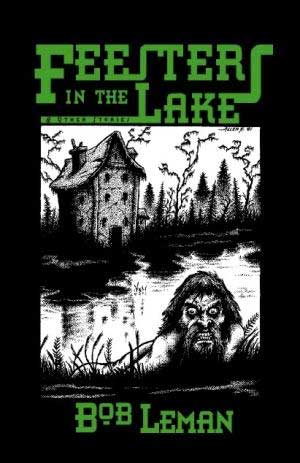
Anyway! I have been sadly poking around the Internet to see if there’s a copy of Feesters in the Lake that by some minor miracle is going for less than $250, and it turns out that while there isn’t, his daughter is hoping to put his complete fanzine online. So that will be something to look at and read through, as it goes.

In the meantime, I will sleep well, and dream of Goster County dogs.

So many words.

It’s been a long week; heavy on the editing, light on the writing, with Thursday being a sick day.

I’ve started reading The Thousand Names, by Django Wexler. I’ve also started putting more of a dent in my magazine backlog, which is kind of huge. And it’s going to get bigger in the next five days, when September’s issues come in. And I have a copy of Fran Wilde’s Updraft on pre-order.

(…and I look at all this and I think oh, goodness.)

My morning glory has continued growing enthusiastically despite the fact that its stem has been broken clear through. It’s put out six flowers in the last week, and grown at least a foot of vines. I’m somewhat bewildered by this, but really, it can’t keep doing this for much longer, can it?

The flowers are getting smaller, at any rate. And paler. But the stem below the break is putting out new leaves, and I’m hoping that I’ll get some new climbing vines before it stops growing. It’s odd to think that it’s nearly September, and October’s just around the corner. I need to start looking up what to do to take care of the garden plants over the winter. (The foxgloves haven’t flowered this year, but I’m hopeful for 2016.)

I am thinking I might need to add a gardening tag, if I keep struggling with the plants.

“I have something to give you. I don’t want it anymore.”

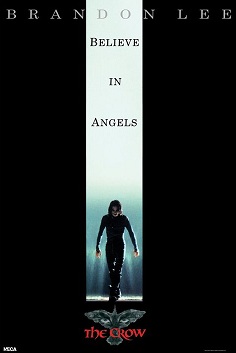
Poster for the 1994 movie The Crow.Last week (I meant to ramble about this earlier, but it’s been a somewhat hectic Thursday-evening-through-weekend), I was talking to a friend about movies, and she mentioned that she’d not only see The Wrath of Khan, she’d snuck out of school to see it when it opened in the theatres. Twice.

I never did that[1], but I was thinking about a movie that I went to see six times in the first month or so after it opened in the theatres[2], and that is The Crow. Murder, revenance[3], rain, fire, revenge, poetry quoted and lines spoken; I loved that movie so very much, and even writing about it now has some of the dialogue chiming around my head and I am smiling.

But I could never remember the ending. I mean, I remembered Sarah being kidnapped, I remembered the fight in the church, I remembered the scene with Shelley at the end. But I never remembered what Eric did to beat Top Dollar. It just went right out of my mind, which I suppose is nice in that it made the fight much tenser, since I wasn’t sure how he was possibly going to survive that.

And it’s odd, to forget that. Because it’s a deeply satisfying moment, in its way.

Same with The Shining–not the movie, this time, but the book. I remember the ending; you will remember what your father forgot, the boiler, the capering figure before the flames. But for the first few years I read it–during which I’m guessing I read it at least three times–I never remembered the scene where Jack smashed his own face with the roque mallet, and what looked out was the Overlook Motel.

In its own way, that’s as pivotal a scene to The Shining as Eric inflicting Shelley’s pain is to The Crow; the one is an extremely visceral representation of the effects of the haunted house, the other’s an encapsulation of revenge that is inarguably earned and was explicitly justified by the target not seven seconds earlier. They could have been written out, but it’s hard to imagine them being replaced by anything that would be better suited to the story.

So I’m honestly puzzled as to why I couldn’t remember them. I first read The Shining when I was eleven or twelve, and I guess it’s possible that I just had trouble grasping the concretization of such an abstract concept, but that makes no sense in the context of The Crow. I was older, and the concept there is a lot less abstract.

And of course, now I’m wondering if there are other things that I’ve forgotten the same way, blanked out after multiple readings or viewings. I suppose I couldn’t tell, which is rather annoying. (I’m guessing I’m not the only person who has these blank spots, but I’m also guessing that other people with these blank spots don’t necessarily share mine. Which makes em even more curious about what causes them, I think.)

[1] Off the top of my head, I am an extremely boring person, and the only school-related movie incident I can recall is when I got so many demerits for staying up reading after lights-out at boarding school that I was grounded and could not go see Bram Stoker’s Dracula the one day it was playing.
[2] The sixth time, my dad went with me and said I wasn’t old enough to see it again. It seems like it would be kind of a moot point by then, but moving on.
[3] This is now a word.

Tiny silver skulls, and old griffins in the cold.

Beasts of TabatBeasts of Tabat by Cat Rambo

My rating: 4 of 5 stars

(Full disclosure: I’ve taken writing classes from Cat. That said, I have liked her work since before I knew to even recognize her name–may I recommend the lovely Events at Fort Plentitude, which I first read in Weird Tales–and I think my review fairly reflects the fact that, dammit, she’s good.)

Short summary: this is a secondary-world fantasy primarily set in the great strange port city of Tabat, which is about to have the Duke step down and hold elections. It revolves around two characters: Teo, a young country boy indentured into servitude at the temple of the Moons, and Bella Kanto, the gladiator whose unbroken string of triumphs in the annual Winter-vs-Spring battle have led to twenty years of long winters and late springs.

(This isn’t a children’s book, by the way. In case anyone was wondering. It’s not gratuitous, but my niephlets aren’t going to be getting this one for a few more years.)

I was expecting a straight-up secondary world fantasy–an adventure, or what you’d traditionally call a romance. There is some of that here; I think you see it most strongly in Teo. But there’s more life than there is just adventure, if that makes sense.

Second, a lot of the fantasy adventures I mentioned are about solving a problem. Beasts of Tabat is so much more than this. There are problems, yes, and some of them get resolved, but this is not a book where the Tour goes around collecting Plot Coupons and applying them to a Clearly Defined Problem. This is coming into a world in flux–on a personal level, a professional level, a social level, a magical level–and watching it turn into something new and wonderful.

(This is perhaps an excellent time to remind people of the origins of words such as “wonderful”, “fantastic”, and “terrific”. Terry Pratchett said it best.)

I think this works because of the attention paid to the characters and the small details. There’s Bella Kanto and Teo, but the characters moving around them and affected by them (I’m particularly engaged by Eloquence Seaborn and Leonoa, but you can take your pick) feel so distinct that those two feel pleasantly more like windows to the world than heroes in it. (I grant Bella Kanto is of heroic stature, but it’s not because of how she’s framed in the text.)

The growing unrest, the prejudice against the Beasts, the changes coming–this is the kind of thing that could get handwaved into a simple didactic dichotomy, and instead the depiction of what living in a world like this is like makes it interesting and involving. I am having opinions about this world, dammit, and I love it.

(There are several other stories set in Tabat, which are listed at the bottom of the page here; I’ve read half a dozen of them, and am going to go read more now that I’ve finished the novel. Just figured I should mention (1) you don’t need to have read them and (2) they’re worth checking out.)

I want to see where this goes. I need to see how it comes out. And it will be wonderful.

Getting sorted.

Not entirely comfortable with how quiet I’ve been this month; going to try and work on that.

Things I’ve been thinking about, and will probably attempt to ramble about in a more coherent fashion over the next month:

  • Superheroic powers as magical realism.
  • Uplifting TV shows. (This is mostly me trying to figure out what exactly it takes to make a show qualify as one. Being funny isn’t enough, and being constructive isn’t enough.)
  • Timing and scheduling, I guess? I’ve started work, and it seems to be going well, but I need to get back on top of my time schedule.
  • Cracked. It’s a police procedural that has a unit where police officers (one of whom is dealing with PTSD-related issues) are teamed with mental health professionals. It’s sort of ridiculously kind. (I was extremely suspicious of this as a conceit, and its execution has kinda smit me.)
  • Days. I actually haven’t talked at all about James Lovegrove’s Days ever here, I think. It is a lovely, strange, funny, and rather weird novel about a day in Days, the world’s first and (provisionally) foremost megastore.
  • Which might actually let me cycle back to “Evening Primrose”, and assorted other fiction with the conceit of “let’s all go live in the shopping mall”.

Counting ink.

It is late, and everyone is discussing 2014. With my habit of getting bogged down in quantifiable minutiae, I am therefore posting about my reading and writing this year.

In 2014, I aimed for 80 books and finished 95, covering a total of 24421 pages.

I was also trying to aim for gender parity in my reading, and I failed. Overall the split was 38:14:43 (the numbers representing female authors:authors of non-binary or unspecified gender, or multi-authored works with a gender mix, or anthologies:male authors, respectively).

  • one was non-fiction. This low number isn’t surprising; I tend to dip in and out of non-fiction works, rather than read them end to end, and I don’t count RPG books as non-fiction. 1:0:0
  • eighteen were short standalones (stories or novellas); most were ebooks, although I did get four in print, including copies of Bob Leman’s “Instructions” and Naomi Mitchison’s Travel Light. 9:1:8
  • sixteen were anthologies! Unsurprising, as anthologies are generally my favourite kind of book to pick up. 2:13:1; the first two were Two of the Deadliest and The Mammoth Book of Ghost Stories by Women, and the last one was The Cthulhu Mythos Megapack.
    (I ran across two other Mythos anthologies this year which only featured male authors, earning Mythos anthologies the distinction of being the only genre of anthology I’ve learned I need to check when I’m tracking gender in my reading, as I clearly can’t assume they’ll actually have a gender mix. A++ Nyarlathotep, carry on. You jackass.)
  • fourteen were collections of stories by a single author (including one of the graphic novels, since the Jonah Hex collection felt more episodic than any of the others). 6:0:8
  • three were RPG sourcebooks. 0:0:3
  • five were game-related fiction: two Wasteland standalones, two Deadlands Noir standalones, and one Pinebox, Texas (now… re-mastered, I guess? as East Texas University) anthology. 0:1:4
  • eight were graphic novels. 0:0:8
    Yes, really. And I thought Mythos anthologies were bad. If you count the writer and the artist as co-authors, that changes to 0:1:7, and my overall stats become 38:15:42
  • twenty-five were ebooks; I read more of these towards the end of the year, and suspect I will read more in 2015. Cheers for a tablet and a new ereader. 11:2:12
  • thirty-seven were novels. 20:0:17

Four of the books I read I five-starred on Goodreads, which is a rating a reserve for books that I think people should read even if they usually pass over that genre (The Last Unicorn, The Inheritance and Other Stories, Save Yourself, and Strong Female Protagonist). 2:0:2, or 2:1:1 if you count writer and artist as co-authors.

Four of them I two-starred, which means I did not hate them but pretty much stopped enjoying them and ground on to see if they would get better. If they had, I would have rated them higher.

And the oldest book I read this year was Naomi Mitchison’s Travel Light, first published in 1952.

I also submitted stories 34 times, and got 31 rejections (although one of those rejections came in for a story I submitted in 2013, so you can say I only got 30 2014 rejections. This does not mean I got four acceptances, but it does mean I am expecting at least four rejections next year. 😉 ) I am slightly embarrassed by how little I wrote; my yearly wordcount hit five digits, but not six.

Happy New Year! See you on the other side.

The glass is half full. Of phosphors.

There's nothing creepy about butterflies, right?
There’s nothing creepy about butterflies, right?

I have had a long day in a few respects, so I am coping by accentuating the positive. Onwards!

After making plans, and waiting for several months (I mean, not many several months; the kind of several months that could also be a few months), I have gotten a tablet. It has a ten-inch-and-change screen, and I am really pleased with it. It occupies a niche closer to a smartphone than a laptop, for me; WiFi only, and not something I expect to do a lot of typing on.

That said, it is better for browsing on than a smartphone (due to the screen size), good for playing light games, and much better for reading on.

I’ve found that if I’m going to e-read (that is a verb, right?), I prefer relatively short pieces of fiction; magazines and anthologies work for me, as do standalone stories and individual issues of comics. Usually I’ve used my Kobo for this; it’s light and fairly durable, has great battery life, and it’s easy to read in direct sunlight. But the eInk screen has a regrettable tendency of freezing in -20C weather or lower (making waiting at bus stops extremely boring), the resolution is fairly low, it doesn’t handle images or zooming very well, and… well, not to be shallow, but it’s in greyscale.

There are certain aspects of the e-reading experience that are not well-served by 800 x 600 resolution in 16-level greyscale.

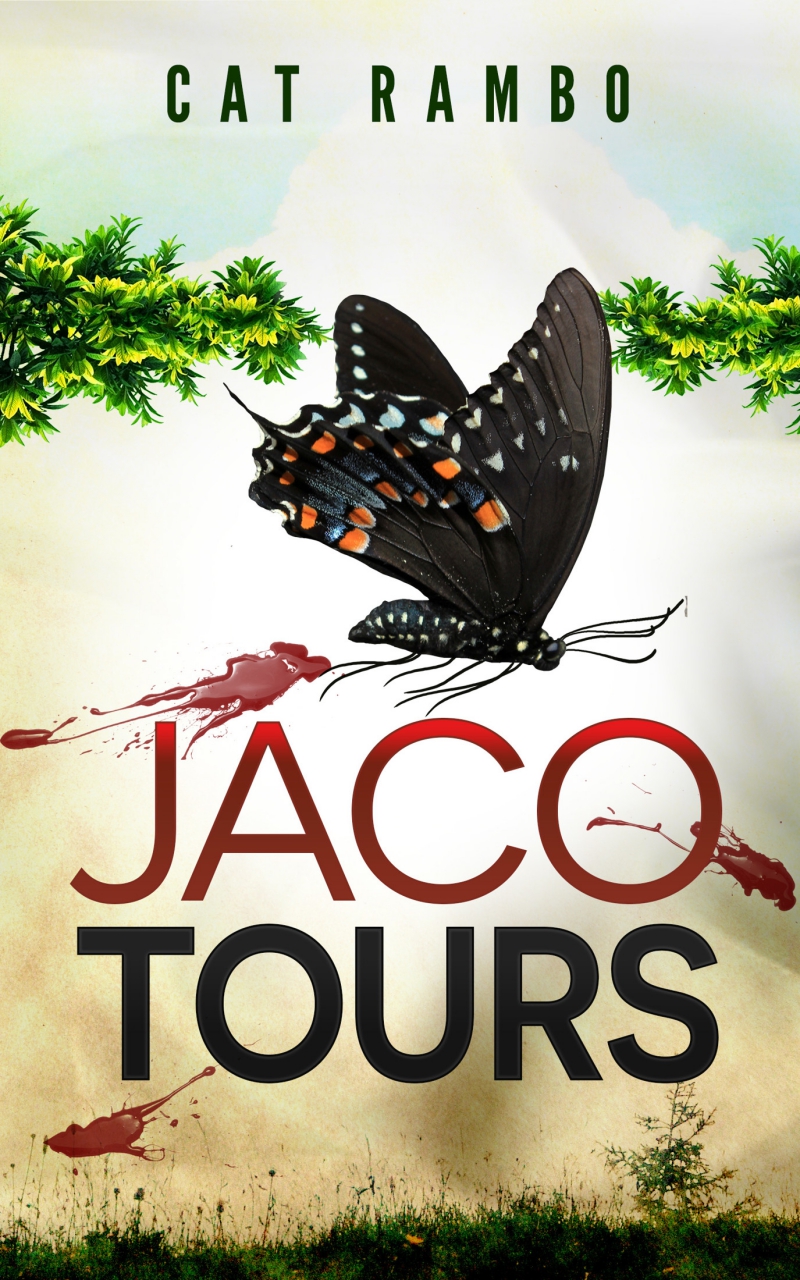
(By the way, I am kind of loving Cat Rambo’s stories, and her covers for same; I think my favourite so far is Her Windowed Eyes, Her Chambered Heart, but since I am not sure how to pull that cover out of my Kindle app, I am tossing up the one for Jaco Tours.)

I need to be careful to stop using the tablet a while before I turn in (backlit screens before bed don’t improve my sleeping any), but it’s really made it a lot easier to get drawn into some of the stories I’ve been collecting. And since I have an upcoming trip (although not to Costa Rica, where Jaco Tours is set), I expect I will be getting a lot of reading in. I look forward to this.

Coming in fast, because music.

I mean, look at this cover.

Because rock’n’roll.

It’s been a really stressful few weeks, and I haven’t been saying much. (I got bitten by a German Shepherd last month, did I mention? Stupid owner.) I’ve been low on time and low on energy, but I ran across something and thought I should mention:

I ran into The Truth of Rock and Roll. (Scroll down.)

I’ve been tired enough that it’s been easy to drop onto TV Tropes and let it eat my attention and my time for fifteen, twenty minutes at a stretch (which is really longer than I’d like right now), and I wandered onto the page for The Truth of Rock and Roll, and…

At first I thought it sounded twee. But the tropes page mentioned a shout-out to that much-loved-by-me Walter-Hill-scored-by-Jim-Steinman this-is-where-the-80s-gets-kidnapped-by-the-70s-and-saved-by-the-50s heartsong of a movie Streets of Fire, and mentioned it was serialized on the author’s blog. And I figured, well, I’d take a quick look. Blogs are easier for me to read than ebooks, and if it’s serialized it’ll have natural breaking points, won’t take up too much time.

(It starts here, by the way. Five parts.)

Take a look.