That thing where the thing looks like another thing but isn’t.

I’ve been watching Riverdale (a fact which has prompted a little self-analysis of what exactly I like in a movie or TV show, but that is neither here nor there), and a recent episode did something that I’m sure there should be a term for.

(Spoilers follow. Oh yes.)

Riverdale, for those of you who don’t watch it, is a pulpy neo-noir crime soap teen drama thriller with a faintly retro feel. It’s clearly fond of classic movies (every episode is named after one, usually crime or thriller but sometimes horror). It’s not quite real in a couple of subtle ways. All the main characters are juniors, but they’re also seventeen years old, for example.

One of the patterns (not hard rules) is that leaving Riverdale doesn’t quite work. In the show, three people have done so. One is Jason Blossom: he died. One is “Mrs Grundy”; she made it to Greendale, but was murdered. One was Joaquin, who left by going on a bus to San Junipero – that’s the eponymous town from an episode of Black Mirror which is actually a fictional world where people’s consciousnesses are uploaded after death. (Before the show began, there was also Archie’s mother, and Hermione Lodge – in the context of the show, they both start outside Riverdale and come back to it.) Archie’s mother gets to leave again, but overall, the pattern you see again and again is that people don’t leave Riverdale, and if they do they die.

So. The episode I’m thinking of was called “Tales from the Darkside” and told three short related stories.

In the first, Jughead owes someone a favour, so he needs to deliver a crate to Greendale. He doesn’t have a car, so he asks Archie to drive his, and while they’re en route a tire blows out. A truck driver comes by; he says he’s going to Greendale, he’s got room for one of them and the crate if they pay him, and Jughead agrees to give him all his money ($18) in exchange for the ride.

The first thing the driver says, once they’re moving, is that for a minute he thought Jughead’s friend was Jason Blossom. The driver (played by Tony Todd) then starts telling Jughead about the Riverdale Reaper, a mass murderer from fifty years ago. They stop for gas, and Jughead discovers that the guy has a dead deer in the back of his truck.

Meanwhile, Archie calls a repair service, gets his tire replaced, and drives on. He reaches the point where the sign on the road says

<- RIVERDALE
GREENDALE ->

and stops for a second. A deer crosses the path, strolls straight across the road, and disappears into the woods behind the sign.

And, alright, practically speaking, it’s not that anyone actually can’t leave. Archie catches up with Jughead and they make the delivery.

But in terms of subtext…

  • Jughead gets a ride from someone.
  • This person, in a show that loves and references movies, and which is specifically referencing horror movies with this episode, is played by the actor who played the urban legend/killer/living story from Candyman, and who was Death in the Final Destination series.
  • The first person the driver indicates he knew is a boy whose defining characteristic throughout the show has been that he’s dead. It drives the entire first season.
  • The first name the driver brings up (and he never brings up his own) is that of the Reaper.
  • This man demands all of Jughead’s money in exchange for ferrying him across the border.
  • We see a living deer as the creature that walks along the border between Riverdale and elsewhere.
  • We see that this man has a slaughtered deer in his truck; literally, the thing that marks the border, destroyed and made powerless.

This is absolutely the story of Jughead being stuck delivering a questionable substance to repay a favour. You know he’s not going to come to a Tales from the Crypt terrible ending. He’s got to stick around. We know this.

But it is also the story of someone being taken across a border by a stranger who is all but wearing a T-shirt saying “Ask me about my role as the Grim Reaper, Guardian of the Threshold and Ominous Bringer of the End.” And we know that as well, and we can enjoy the beats of that story even as we are sure they will never happen. And the beats of that story both exist and shape our expectations of what will actually happen.

There’s a word for this, isn’t there? Telling one story, but telling it in the shape of another?
Westworld

First: I am not impartial about this show. It is beautiful, both visually and in terms of each episode’s construction. It is richly nuanced. It is thoughtful. Unless it takes a sharp right turn off a high cliff, I think it is going to be the best science fiction show I’ve seen this year.

Second: I have not yet seen more than the second episode, and it’s the second episode I want to talk about. (Of course, this might be the kind of thing people have already established in cast interviews, or something, but I’m going to put it under a cut for spoilers anyway.)

Read more Westworld

Of fine bookery

Orrin Grey’s excellent collection, Never Bet the Devil & Other Warnings, is coming back into print! There’s a Kickstarter currently running for the new edition, so I am going to have two copies of it, and one of them will come with an extra story and some e-phemera. The stories in this book are lovely; I may have mentioned “The Seventh Picture” before, and I continue to live in the hope that someone will someday make a movie out of that one.

My review of the initial edition is here, but I figured I’d yank a partial paragraph:

There’s horror here, yes, but that’s not all that’s important here; Never Bet the Devil would be an impressive but rather cold book if it was. The infinite strangeness of the supernatural, that was what I was having trouble defining, and a love for the strange and supernatural elements of the genre. The stories, taken together, are stories of horror, and loneliness, and madness, and mystery. And they still manage to convey a sense of wonder. Not overwhelmingly so; I don’t think it’s possible to come away from them thinking cheerful thoughts. But dammit, reading stories like this, stories that have these things in them… this book makes me happy, and the reading has improved my days.

Overall it comes out to less than $2 a story to get a digital copy, and these are some really, really lovely stories, even without the illustrations. Worth checking out.

Certain lines can’t be uncrossed,
Certain maps will get you lost,
Once you’ve past the border then you’ll have to play the game.
Roll the dice but count the cards,
Break the glass but keep the shards.
The world is out of order. It’s been broken since you came.

The broken doors are hidden in the blood and in the bone.
My darling child, be careful now, and don’t go out alone.

This is an odd one because the work itself doesn’t exist.

What I’m quoting is a fragment of Don’t Go Out Alone, a children’s book that exists in-universe in Mira Grant’s Parasite, but is not confirmed to be fully transcribed. (Mira Grant is a pen name used by Seanan McGuire, so we’ve got an author who created an author who created an author… it’s turtles all the way down. Well, turtles with scalpels.)

Parasite is a lovely book; compelling characters, good pacing, a mounting sense of dread. The lines from Don’t Go Out Alone just chime through it and accentuate it. Absolutely worth reading.

The proof is this: they are here, the Goster County dogs.

This is one of those moments where you really need to read the story in order to appreciate the line, which on the one hand I kind of tend to avoid–but on the other hand after four years of wanting a copy of Bob Leman’s collection Feesters in the Lake, I am looking like I will actually get a copy of Feesters in the Lake, and I am celebrating.

I’ve spoken about Bob Leman before. His writing, from what I’ve seen, is elegant and restrained. I’m not sure I’d go so far as to call it understated, but his horror whispers, it does not shout.

You can read “Loob” in full at Weird Fiction Review.

I shall plan my cousin’s escape from that Canton mad-house, and together we shall go to marvel-shadowed Innsmouth. We shall swim out to that brooding reef in the sea and dive down through black abysses to Cyclopean and many-columned Y’ha-nthlei, and in that lair of the Deep Ones we shall dwell amidst wonder and glory for ever.

Oh, I have so much to say about Lovecraft.

The first work of his I read was either “The Dunwich Horror” or “Pickman’s Model”. I didn’t start noticing how stridently he kept bringing up race and miscegenation for a long time, to which the only defense that I can offer is that I started way young (and I actually have something else to say about my tendency to not question authorial voice, which is a different issue for another time).

But this quote; this one chimes with me. Because while I believe Lovecraft thought he was writing a terrible horror story about the triumph of degeneration, the more I read it the more it’s about a triumphant escape, and coming home, and realizing who you are to dwell in a place of loveliness and acceptance.

(Also, you know, Deep Ones. Who are neat, although I prefer ghouls.)

For now, they had simpler concerns. Keeping the children from the roofs at night, the bereaved from crying out too loud, the young in summer from falling in love with the human. It was a life.

I think this one appeals because it actually focuses on the quiet or peaceful life of a society, rather than a handful of individuals. It kind of pulls back and gives you space to relax.

(Also, you know, hidden society of monsters.)

Mind, I generally find Barker’s style to be dreamy and faintly detached; I’m not sure it would work as well if he wasn’t building on an entire novel in the same vein. Either way, though, it’s very relaxing.

AP/Nassau: The excursion liner Carib Swallow reached port under tow today after striking an obstruction in the Gulf Stream off Cape Hatteras. The obstruction was identified as part of a commercial trawler’s seine floated by female corpses. This confirms reports from Florida and the Gulf of the use of such seines, some of them over a mile in length. Similar reports coming from the Pacific coast and as far away as Japan indicate a growing hazard to coastwise shipping.

That cheery fragment is actually one of the less upsetting pieces of text in Tiptree’s “The Screwfly Solution”. It’s a fairly hard-hitting story, especially when you (for example) go in thinking that while it’ll probably be a good story, it’ll be a little dated and there’s no reason to think it’d make more of an impression than others you’ve read.

(I was corrected. To borrow a phrase from another work, I was corrected harshly.)

That short story’s remarkable to me at least in part because I honestly feel like the last few lines weaken the horror of it. Partly that’s surprising because I find most of Tiptree’s work is remarkably consistent and builds well on itself; partly that’s interesting because I’ve got a class on beginnings and endings tomorrow, and I’ve been thinking a lot about them lately.

Tiptree wrote a great many stories, and it’s hard to choose what to recommend first, but after “The Screwfly Solution” you could do worse than go with “Your Faces, O My Sisters! Your Faces Filled of Light!”, “The Man Who Walked Home”, and “The Girl Who Was Plugged In”.

Yellow.

The yellow sign.
Probably familiar. Probably.

I have (probably not very surprising) a kind of abiding fascination with the King in Yellow. An imaginary play created by Robert W. Chambers in 1895, it’s one of the go-to examples of the motif of harmful sensation; the sound or sight or text so horrible that it damages the one who experiences it.

(Incidentally, yellow appears as a colour associated with horror rather more often than I’d expect. Red and black are easy and obvious associations, and you can get a lot of mileage out of an eerie green light[1], but yellow… there’s the King in Yellow, Gilman’s famous yellow wallpaper, the sickening yellow haze in King’s room 1408, and another one just at the tip of my memory. It is a very unwell colour, I suppose.)

I am not the only one. (I own two anthologies devoted specifically to King in Yellow stories, and another one is coming out late this year.) There are stories which frame the King in Yellow as a play (Brian Keene’s “The King, in Yellow” is the only one I can think of off the top of my head, and several which frame it as a text, but several (including two of my favourites[3]) frame it as a movie. I can’t think of any other mediums of expression; I’ve never read a story about a King in Yellow video game, or dance performance. I can’t call to mind treatments of it as a story, either (that is, a work of prose fiction, rather than a script or a performance produced from a script).

That said, I do know that John Horner Jacobs’ Southern Gods features a detective looking for the recording artist Ramblin’ John Hastur. I have my suspicions about that, but I haven’t actually been able to lay hands on a physical copy of the book. (It’s on my to-do list.) It’d be interesting if there are King in Yellow references in there, particularly as Ramblin’ John is a blues musician; it’s an art form much more strongly associated with improvisation than scripted plays, and I’d be curious to see how the interpretation differs as a result.

[1] Or a regular light and a green skirt.[2]
[2] Kind of curious to see if I have tied this post into obscure knots, or if that reference actually makes sense.
[3] Those would by Orrin Grey’s “The Seventh Picture” and Silvia Moreno-Garcia’s “Flash Frame”. “The Seventh Picture” is in Candle in the Attic Window and Never Bet the Devil and Other Warnings, and “Flash Frame” is in Cthulhurotica, The Book of Cthulhu, and This Strange Way of Dying, and is in audio at Tales To Terrify No 9 David Thomas Lord. For the record.

“I have something to give you. I don’t want it anymore.”

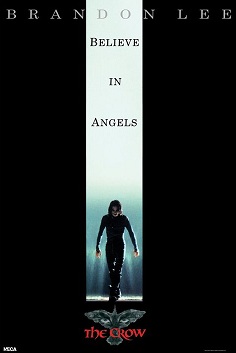
Poster for the 1994 movie The Crow.Last week (I meant to ramble about this earlier, but it’s been a somewhat hectic Thursday-evening-through-weekend), I was talking to a friend about movies, and she mentioned that she’d not only see The Wrath of Khan, she’d snuck out of school to see it when it opened in the theatres. Twice.

I never did that[1], but I was thinking about a movie that I went to see six times in the first month or so after it opened in the theatres[2], and that is The Crow. Murder, revenance[3], rain, fire, revenge, poetry quoted and lines spoken; I loved that movie so very much, and even writing about it now has some of the dialogue chiming around my head and I am smiling.

But I could never remember the ending. I mean, I remembered Sarah being kidnapped, I remembered the fight in the church, I remembered the scene with Shelley at the end. But I never remembered what Eric did to beat Top Dollar. It just went right out of my mind, which I suppose is nice in that it made the fight much tenser, since I wasn’t sure how he was possibly going to survive that.

And it’s odd, to forget that. Because it’s a deeply satisfying moment, in its way.

Same with The Shining–not the movie, this time, but the book. I remember the ending; you will remember what your father forgot, the boiler, the capering figure before the flames. But for the first few years I read it–during which I’m guessing I read it at least three times–I never remembered the scene where Jack smashed his own face with the roque mallet, and what looked out was the Overlook Motel.

In its own way, that’s as pivotal a scene to The Shining as Eric inflicting Shelley’s pain is to The Crow; the one is an extremely visceral representation of the effects of the haunted house, the other’s an encapsulation of revenge that is inarguably earned and was explicitly justified by the target not seven seconds earlier. They could have been written out, but it’s hard to imagine them being replaced by anything that would be better suited to the story.

So I’m honestly puzzled as to why I couldn’t remember them. I first read The Shining when I was eleven or twelve, and I guess it’s possible that I just had trouble grasping the concretization of such an abstract concept, but that makes no sense in the context of The Crow. I was older, and the concept there is a lot less abstract.

And of course, now I’m wondering if there are other things that I’ve forgotten the same way, blanked out after multiple readings or viewings. I suppose I couldn’t tell, which is rather annoying. (I’m guessing I’m not the only person who has these blank spots, but I’m also guessing that other people with these blank spots don’t necessarily share mine. Which makes em even more curious about what causes them, I think.)

[1] Off the top of my head, I am an extremely boring person, and the only school-related movie incident I can recall is when I got so many demerits for staying up reading after lights-out at boarding school that I was grounded and could not go see Bram Stoker’s Dracula the one day it was playing.
[2] The sixth time, my dad went with me and said I wasn’t old enough to see it again. It seems like it would be kind of a moot point by then, but moving on.
[3] This is now a word.