Today’s actually been a really good day. It was a low-pressure morning, I got the tracking information for my incoming shinies, I installed and noodled around on Pillars of Eternity, and I went to go see It Follows with the light of my life. (Who discussed doing science to the monster in the car on the way back.)
Pillars of Eternity is fun; it feels a lot like playing Baldur’s Gate back in the day[1], although I haven’t yet resorted to the tactic of summoning kobolds to fight for me and then looting the short bows for resale when they got killed and disappeared in a puff of smoke. It’s a bit crunchy, it feels fairly linear so far, and it has some gleefully creepy moments that I’ve been enjoying greatly. It’ll be good to play through, I think.
It Follows was… I don’t want to say it was surprisingly good, because I wasn’t expecting it to be bad. (Following under cut due to spoilers–mild ones, but it’s a really solid movie and people should get to watch it without spoilers if they so choose.) Read more Hectic times
(Yes, well, it’s the holidays. I can’t use the mouse too much, but games which are heavily or primarily keyboard-accessible? I am all over those.)
So, I finished Walking Dead: Season 2–the story game, not the TV show, definitely not the Walking Dead™: Survival Instinct game which from what I’ve heard is absolutely terrible–and it was good. (I generally find the Telltale Games stuff to be really good; the only work of theirs I haven’t picked up is the Game of Thrones one, and if they ever do a 100 Bullets game I will probably go missing for several hours at regularly spaced intervals. I find they don’t branch as much as the Choice of Games narrative fiction, but they are very good at inspiring an emotional connection with the characters.)
Anyway, the game’s been out for a year or for four months (depending on whether you count from the first or last episode), but I realize some people may not have played it yet, so I’m putting the rest behind a cut. Read more Walking Dead: No Going Back
Okay, here’s a question: I am looking for examples of fictional narrative in which the author and the reader both know and learn more about the world than the narrator/protagonist/viewpoint character(s).
Examples of what I am speaking of, off the top of my head:
“Petey” – TED Klein
“The Events at Poroth Farm” – TED Klein (I sense a theme)
“Fat Face” – Michael Shea
that story whose title I can’t remember from the New Cthulhu: The Recent Weird anthology in which the narrator assumes he’s observing the behaviour of crayfish
(The latter three are probably easier to pull off, in that the protagonists discover the facts they are ignorant of before the end of the story. “Petey”, on the other hand, remains a story that in this regard is so beautifully executed I am in awe every time I read it. I will probably be picking it up to look at it, but )
The important thing to note in these stories is that the truth of the fictional narrative is not the reader’s default reality (or, if one of these was set in Regency England or Ancient Egypt, their assumption of what a default reality should be). “Fat Face”, for example, involves shoggoths; assuredly cuddly, but generally not assumed to exist in real life. Contrast this with any one of three dozen narratives in which someone is running around the street seeing ordinary people as “demons”; I am really not hugely interested in examples of the latter, since they are generally a way to tell the reader about the narrator and not about the world.
Finally, I’m looking for text only. This means that things like the I Am Legend movie do not count. It is a wonderful example of how what the viewer can see is really going on (as displayed on film) does not match what the protagonist asserts is going on, but I really want to see how this is made to work in text.
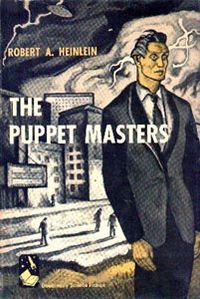
Not the edition I would have picked up in that bookshop.
Okay, that’s a lie. I read a Heinlein novel during a university course on science fiction. It was Starship Troopers, and it was contrasted with Haldeman’s Forever War. And I may have read part of The Puppet Masters, but since I only remember a bit about how some clothing (hats? coats? tops?) was being outlawed, it is more probable that I just picked it up at the neighbourhood secondhand bookstore and read a few pages. I liked to hang around the SF section and do that sometimes, and it’s left me with an eclectic collection of snippets–that bit, something about a Doctor Who novelization in which a villain had attached a canister of horrible mutagen to Peri[1], and a rich tourist who went to the Savage Theme Park of New York and was stuck there after it was closed for the season.
(Those bits are rather vague, since I would have been between seven and eleven at the time–more than two decades ago.)
But when I was growing up, I didn’t read Heinlein.
I have been thinking, lately, about a line from Toni Weisskopf’s blog post, “The Problem of Engagement,” which runs:
Well, Heinlein is one of the few points of reference those fans who read have. Of course we all read Heinlein and have an opinion about his work. How can you be a fan and not?
I am a fan who reads; horror by first choice, yes, but I always read SF and fantasy when there wasn’t enough horror around. I have loved Worlds-That-Are-Not (or Worlds-That-Are-Not-Quite) for many many years, and I found them through books. I have been, I would have said, one of those “fans who read” for a very long time.
But I didn’t read Heinlein.
See, the first time I picked up Heinlein with a recognition of who the author was supposed to be (this name I’d heard about, seen on book spines, was told was incomparable), in the hope that I would enjoy it? I would have been about twelve; my family was in Algeria at the time, and the English fiction library we had access to was in a repurposed basement. The entirety of the genre section was a single bookshelf, and I made a heartfelt effort to go through all of it.
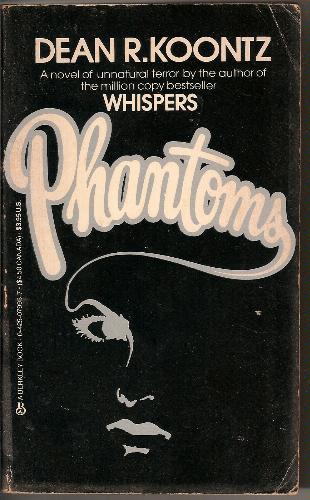
This, on the other hand, is the exact edition of Phantoms I read in that library.
I’m going to digress for a moment, and talk about Dean Koontz.
I discovered Dean Koontz and Stephen King on that same bookshelf (while I’d seen a secondhand hardcover of Cujo a few years earlier, I hadn’t been allowed to read it). Dean Koontz was easier to get a hold of, and often more snappily paced, and I would guess I read a good twenty or so of his books in the next few years. I probably overdid it, and I’d occasionally joke about how I could summarize the commonalities of plot of his novels in a single sentence. I got bored with him, and quit reading. (I’m drifting back, now, but that’s another story.)
But.
When I was twelve, when I was bored and had basically no-one to talk to, when I was starving for something to read and I went through that bookcase, here is what I found in the first handful of pages:
The first Heinlein novel I picked up, I read about a guy watching his daughter strip her top off and being proud that she was checking with her husband instead of with him to be sure it was okay.
The first Koontz novel I picked up, I read about a doctor who was taking care of her little sister and who’d bluffed an evil biker gang leader[2] into believing that she was too damn scary to mess with.
Goddamn right I wasn’t interested in more Heinlein. And my take on his work is and remains “I don’t know it,” and I don’t think that’s informed or detailed enough to count as an opinion.
And when I was back in Canada… well, I met other people I could talk to about this genre thing, and we swapped recommendations, and I know some of them liked Heinlein but none of them ever made anything he’d written sound cool enough for me to bump him onto my must-read list. And then there were things like university and work and now, sad as it makes me, I don’t have the time to read that I used to. For a little while in eighth grade I was getting through five books a week. These days I’m lucky to clear eighty books a year.
It doesn’t make me happy, but I can live with that.
So when it comes to the question of
Of course we all read Heinlein and have an opinion about his work. How can you be a fan and not?
It’s not that hard. You just find other things that suit you better, and listen for things that people describe in such a way that they sound actually enjoyable, and you don’t have unlimited time.
And to that, Weisskopf wrote:
So the question arises—why bother to engage these people at all? They are not of us. They do not share our values, they do not share our culture.
I can live with that, too. And my reaction to that is much the same as my reaction when I put down Number of the Beast. I don’t have time for this, I have not seen enough to suggest I will enjoy this, and so I will leave this behind and go find something that will brighten or deepen or enrich my day.
And if that decision means I am not of your culture, that I do not share your values, I am sure we will both be much happier for it.
—
[1] Unsurprisingly, it didn’t work. If I recall correctly, the mutagen canister was removed from where it was attached to Peri’s belt, and was ?thrown? at the villain, where it interacted with a wooden stake he was standing near. The mutagen then worked on the wooden stake, causing it to explode outwards into a spiky lattice of stake-y wood and skewer the villain to death.
[2] I am not saying Phantoms was particularly nuanced. (Jeter, the man in question, is further developed later in the novel. I would say the development was done to add horror, not subtlety or multi-faceted characterization.)
Apparently “watch all the Freddy Krueger” is this week’s recipe for decompression. The first few were watched after work, and today has been a marathon of terrible puns, body humour, body horror, and an origin story which cheerfully has more and more gingerbread added to it every other movie or so. (Child murderer! Who was the “bastard son of a hundred maniacs”[1]! Buried in ground that was deconsecrated by a dreaming dog peeing on it! And who was chosen by dream demons as the most evil person ever and given his powers! And who’s actually something greater and older than all these things–)
(Oh, Freddy.)
(Also, I’d apparently somehow completely missed seeing the sixth movie until earlier tonight. No idea how.)
And yet, I get why he appeals. I think, if I looked at the movies now, if I saw them in a vaccuum, I might not see enough to prompt the level of weird creeped-out fondness for the character that I currently have. But I’m not in a vaccuum, and that’s Freddy Krueger. When I was a kid waiting for the schoolbus, I picked up what must have been (I have determined through looking it up since) Freddy Krueger’s A Nightmare on Elm Street. It was a black-and-white comic, and I mostly just remember someone choosing the path that led away from flowers and fluffy bunnies and towards gross icky stuff, and that it ended with this page.
I would had to have been, I think, no older than eleven. That comic was not something I could afford, and it was not something I would have thought of actually owning anyway, I think.
But it was unspeakably neat. I mean, monsters and bad dreams! And the bad guy was telling jokes! And the art was much cooler than Archie comics and a lot more polished than the horribly cheesy B&W science-horror comics I had seen to that date. So I read it in dribs and spurts, sneaking it off the shelf at the corner store and going through a few pages and then putting it back on the rack when the school bus got there.
And that was how I met Freddy Krueger. I didn’t see any of the movies until years later, and the first one I saw was actually Dream Warriors, which I think was not the best of the bunch. But I knew who he was, because everyone knows who he was. Oh, not in a super-important way; I don’t think I ever even heard him mentioned as a topic of discussion for years. But he’s part of the background radiation of cultural consciousness.
It’s been interesting, deliberately concentrating on the source material instead of simply settling for what I already know.
—
[1] Oh don’t get me started. But anyway.
I am having one of those days, and today that day is one of those which involves trying to come up with a great long list of creatures (probably mythological or folkloric) which are particularly associated with biting or human-eating (most often corpses, but I am willing to be flexible).
Off the top of my head:
Ghouls. I don’t feel this one needs elaboration, except to point out that I do not mean D&D ghouls.
Redcaps, if the terrible bite schtick actually predates White Wolf’s Changeling: The Dreaming. I can’t actually find a cite for that (yet), and simply having huge teeth doesn’t count.
Aswangs. Creatures from Filipino folklore that eat human meat–corpses, but also the living, or unborn fetuses. (Fetusii? >googles< No, fetuses. Right, then–carry on.)
Zombies, the movie version. (The light of my life actually had to point this one out to me. I have no idea why.)
Werewolves, not because the bite is (sometimes) infectious, but strictly for the killing and eating of humans when it shows up. Also a hat-tip to CS Lewis and the classic line “Where I bite, I hold till I die, and even after death they must cut out my mouthful from my enemy’s body and bury it with me.”
Related to that, the wolf in Little Red Riding Hood. Not one I would have initially thought of, but the swallowing of bodies whole and in such rapid succession is impressive, even if they were alive. I may be being swayed by the fact that in some versions of the story, LRRH is actually called “Red Cap”.
Wendigos. Which I also do not feel needs elaboration.
Vampires specifically do not count, because of all the surviving/not noticing of the bite (at least the first time) and the distinction between drinking and eating.
Back in December, I mentioned that I’d picked up a collection of eight horror movies for five bucks. The recognizable one[1] is the original Night of the Living Dead, so I’m not going to be putting that on. However! There is also Colour from the Dark, a movie which instantly raises the burning question “Did the writers read “Colour out of Space”, or is this a direct rip-offtribute derivative of the very-understandably-forgotten The Curse[2]?”
A family accidentally frees something from the Earth’s womb while drawing water from their well and now a sinister glow is seeping into their lives.
The Bleeding Edge is a 2009 limited-run (500 copies) horror anthology published by Cycatrix Press. Since I’m having trouble writing, and managing to read, I thought I could at least use my reading as grist for some writing:
A solid collection with one weak point and a few very good ones. There was a distinct disunity of style and format (teleplays and scripts) that was actually rather appealing.
The box store near our place is being bought out, so everything is on sale. This means it is possible to do things like buy horror DVDs for somewhat less than $2. Or, perhaps, an eight-movie collection for less than $5.
These are going to be terrible.
I have started with After Midnight, the standalone DVD. The frame story is about a certain Professor Derek teaching a course in the psychology of fear, and I am bravely resisting comparisons to Clive Barker’s “Dread”. We start with Allison (our protagonist) and her friend (you know, the protagonist’s friend… it’s an 80s movie, you can fill her in) going to class, with Allison explaining that she didn’t sleep well, and she has a bad feeling about the class they’re going to take…
Plot summary, spoilers, and brief rating follows the cut.
I noticed a certain common colouration in the books I had to hand:
I’m cheating a bit with this picture, since both the hardback cover and the dustjacket of Breed are shown. (I took the dustjacket off because something about the paper just feels subtly repellant–some weird combination of sooty and greasy.) On the flipside, I’m not including The Rivals of Frankenstein, which continues the black-white-red theme, so it all balances if anyone’s keeping score, which I sort of doubt.
Am mildly amused by this, especially since the other books I am reading, or have just finished, or have just started, have a black-and-white thing going for the covers. (Apparently the subtraction of red takes you from horror to crime, who knew? Although Bedlam is an exception to that.)
Not feeling well today; I’m hoping it’s just after-effects of the flu shot, since those should clear up more quickly than anything I might have actually caught. Managed to get a little cleaning done, though, and get out of the house to pick up groceries and return library books. (Mildly annoyed that one of the books I have on hold has been in transit for just over a week, now, and is still not at the local branch. It’s a Lovecraft collection, so I suspect I could find the contents on Gutenberg, but I find I really prefer physical copies of anthologies and collections. Screens and ereaders work best for single works, for me–novels or novellas or standalone short stories, any length is fine, just not several short stories.
Probably turning in early tonight; the nap after the vet’s was nice, but I’m still wiped.