Of fine bookery

Orrin Grey’s excellent collection, Never Bet the Devil & Other Warnings, is coming back into print! There’s a Kickstarter currently running for the new edition, so I am going to have two copies of it, and one of them will come with an extra story and some e-phemera. The stories in this book are lovely; I may have mentioned “The Seventh Picture” before, and I continue to live in the hope that someone will someday make a movie out of that one.

My review of the initial edition is here, but I figured I’d yank a partial paragraph:

There’s horror here, yes, but that’s not all that’s important here; Never Bet the Devil would be an impressive but rather cold book if it was. The infinite strangeness of the supernatural, that was what I was having trouble defining, and a love for the strange and supernatural elements of the genre. The stories, taken together, are stories of horror, and loneliness, and madness, and mystery. And they still manage to convey a sense of wonder. Not overwhelmingly so; I don’t think it’s possible to come away from them thinking cheerful thoughts. But dammit, reading stories like this, stories that have these things in them… this book makes me happy, and the reading has improved my days.

Overall it comes out to less than $2 a story to get a digital copy, and these are some really, really lovely stories, even without the illustrations. Worth checking out.

Time, and salt, and gannets

May was… long. I will speak no more of it than I already have.

The latest On Spec Magazine has been published, and contains my short story “Gannet Girl”; you can also get an electronic version of the issue here.

Gannets do not love humans, but they can see eye to eye with them. It’s a matter of some import.

(And in other news, the No Shit, There I Was… anthology funded, and I signed the contract and received payment; backers will get their copies, and then the book’ll be available to the general public.)

Certain lines can’t be uncrossed,
Certain maps will get you lost,
Once you’ve past the border then you’ll have to play the game.
Roll the dice but count the cards,
Break the glass but keep the shards.
The world is out of order. It’s been broken since you came.

The broken doors are hidden in the blood and in the bone.
My darling child, be careful now, and don’t go out alone.

This is an odd one because the work itself doesn’t exist.

What I’m quoting is a fragment of Don’t Go Out Alone, a children’s book that exists in-universe in Mira Grant’s Parasite, but is not confirmed to be fully transcribed. (Mira Grant is a pen name used by Seanan McGuire, so we’ve got an author who created an author who created an author… it’s turtles all the way down. Well, turtles with scalpels.)

Parasite is a lovely book; compelling characters, good pacing, a mounting sense of dread. The lines from Don’t Go Out Alone just chime through it and accentuate it. Absolutely worth reading.

Magical alphabet noir

I have a short story that’ll be appearing in the No Shit, There I Was… anthology from Alliteration Ink! The anthology theme is pretty straightforward; you could submit any specfic story, as long as it started with those five magic words. It’s currently being funded on Kickstarter; an ecopy of the anthology is $5, although nearly as many people are going for the trade[1].

Alex Acks is doing a daily discussion of the stories over on his blog while the Kickstarter is running, and today he wrote about mine; you can read what he had to say here, and I am sharing this because I am… well, gleeful and flattered and so pleased that apparently my story did what I wanted it to do!

(The discussions are compiled under the no shit anthology tag, and make for excellent reading, joint and severally.)
  =====
[1] Omigod more of my words are going to be in print.

The Western Weird.

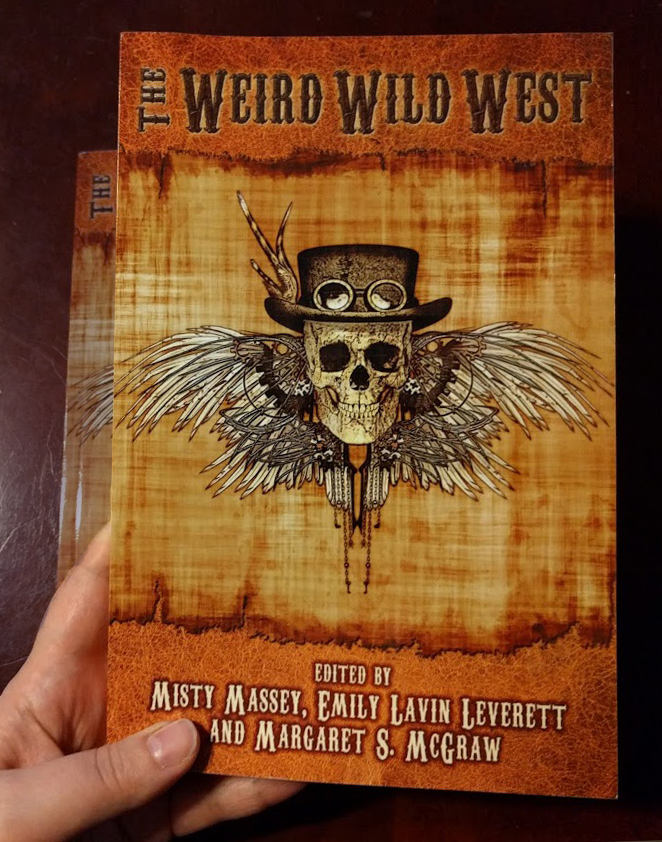
Yesterday, my contributors copies of The Weird Wild West came in. (They should have come sooner, but apparently there was some trouble, for which I suspect I should blame Canada Post; in any case, I would like to say that everyone at eSpec Books was absolutely lovely to deal with, and thank them all.)

I’m in a book. I’m in a book with an ISBN, and people said nice things about my story. One of the editors had a lovely reaction to it, and Amazing Stories called it a strong start to the anthology, and overall I am hugely pleased.

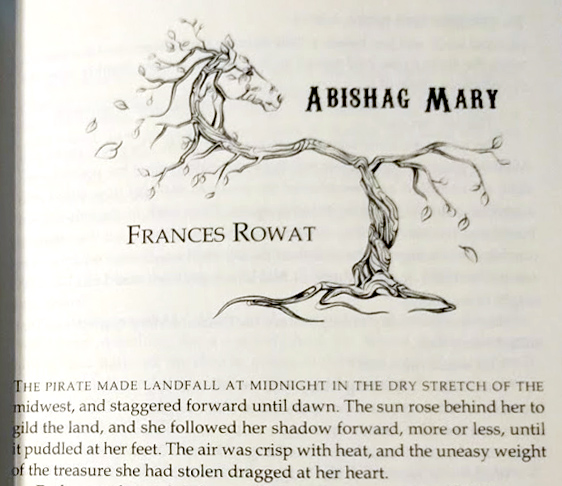
WWW_insideAnd the art is beautiful. I can’t take a good picture of any of the full-page pieces (and I suspect that might not be cool, in any case), but look at my extremely clumsy picture of that beautiful story header. Look. <3

Anyway, it’s on Amazon; you can get it starting at $5 for the ebook, or in trade paperback. And there’s a lovely page at the front with all the author’s names, and space for signatures; I’m planning to take one of my copies to cons, and get as many as I can.

The proof is this: they are here, the Goster County dogs.

This is one of those moments where you really need to read the story in order to appreciate the line, which on the one hand I kind of tend to avoid–but on the other hand after four years of wanting a copy of Bob Leman’s collection Feesters in the Lake, I am looking like I will actually get a copy of Feesters in the Lake, and I am celebrating.

I’ve spoken about Bob Leman before. His writing, from what I’ve seen, is elegant and restrained. I’m not sure I’d go so far as to call it understated, but his horror whispers, it does not shout.

You can read “Loob” in full at Weird Fiction Review.

Oh, where are you coming from, soldier, gaunt soldier,
With weapons beyond any reach of my mind,
With weapons so deadly the world must grow older
And die in its tracks, if it does not turn kind?

Stephen Vincent Benét isn’t very well-known for his science fiction, as far as I can tell; he wrote “By the Waters of Babylon“, and the story is known, but since he was better known for other work and came to science fiction late in a relatively short life, his name doesn’t bubble to the top very easily in genre discussions.

I ran across the poem while looking up The War Game (1965, BBC, an “and you though Threads was upsetting” kind of mockumentary), which uses it as an epigram. About once every eight months I run across it again, and then I spend three days humming it to a tune that’s something like “The Streets of Laredo”.

This time, I thought I’d share; the text in its entirety is here.

Oh, write.

So in the last week I got bitten by the writing bug again, which – combined with waking up before 6 a.m. every morning – has resulted in several thousand words. This is not great, compared to what I’ve done in the past, but it is certainly one hell of an improvement.

I’ve missed this “have to get it down!” feeling. I’m not sure if it’s been absent due to stress or weather or what, but I’m really glad it’s back.

For now, they had simpler concerns. Keeping the children from the roofs at night, the bereaved from crying out too loud, the young in summer from falling in love with the human. It was a life.

I think this one appeals because it actually focuses on the quiet or peaceful life of a society, rather than a handful of individuals. It kind of pulls back and gives you space to relax.

(Also, you know, hidden society of monsters.)

Mind, I generally find Barker’s style to be dreamy and faintly detached; I’m not sure it would work as well if he wasn’t building on an entire novel in the same vein. Either way, though, it’s very relaxing.

Red and gold.

It astonishes me to realize that, for all that I adore the show The Flash, I’ve only mentioned it here a couple of times. So, in the name of breaking the week-long quiet streak that has resulted from travelling home, landing in a snowstorm, and shortly thereafter getting extremely sick, I am going to discuss the show that is currently my comfort watching.

When I started watching, I knew very little about the Flash. I knew that he was a speedster from DC comics; I knew that he worked with Superman sometimes; I knew that DC speedsters ran off something called the Speed Force, a kind of platonic ideal or Ur-speed that inhabits speedsters to a greater or lesser degree. And from cultural background radiation, I apparently knew that liquids floated as if they were in zero-G in the presence of the speed force, although I didn’t know I knew this until the light of my life showed me the promo trailer.

(Seriously. There’s more than a minute of this kid called Barry, and lines about being fast enough and having a good heart, and a man in a ball of lightning, and it’s all nagging faintly at me like I should recognize something, but what tips me off to it being a Flash trailer is the liquids in the lab getting all floaty.)

I also knew that I didn’t really like DC. I would take at least a look at any Vertigo comic, and I liked the Batman collection I had (which was actually a Joker collection), and I loved Kingdom Come. But overall the whole superheroes-as-gods thing didn’t hugely appeal.

But I watched the first episode of The Flash, and… okay, it had a bit of pilot-itis, and what looked like an extremely generic unrequited-love thing, but there was this kid. This really kind, hopeful kid. And as cool as his powers were he wasn’t in control of them so I wasn’t getting the “speed god will solve every problem” vibe. And… honestly, I came out of the first episode thinking “He’s like Peter Parker, except his job actually helps people.” And he didn’t have the ‘got powers, was painfully selfish until someone died’ thing going that Parker did, and…

He was hopeful. The whole show was hopeful, a four-colour major-key paen to saving people and supporting each other and powers as attribute embodiment and the ways tech is awesome and interesting and can be used to help people. He was… inspirational, I guess?

I gushed about this a little to the light of my life, and he pointed out to me that there was a reason Barry Allen had been chosen as an avatar of hope in DC comics. (Which was something else I didn’t know.)

This is, I think, discussed in greater detail with better construction and more coherence by Eric Burns-White (a guy who seems to have an excellent grasp of certain essentials of pulp-printed fiction, and is a hell of a lot more articulate than me), in his essay “My name is Eric Burns-White, and I have almost always hated Barry Allen.” Which I’m recommending as someone who adores the Barry Allen she’s seen to date, and can completely understand why the Barry Allen described would be an extremely annoying character.